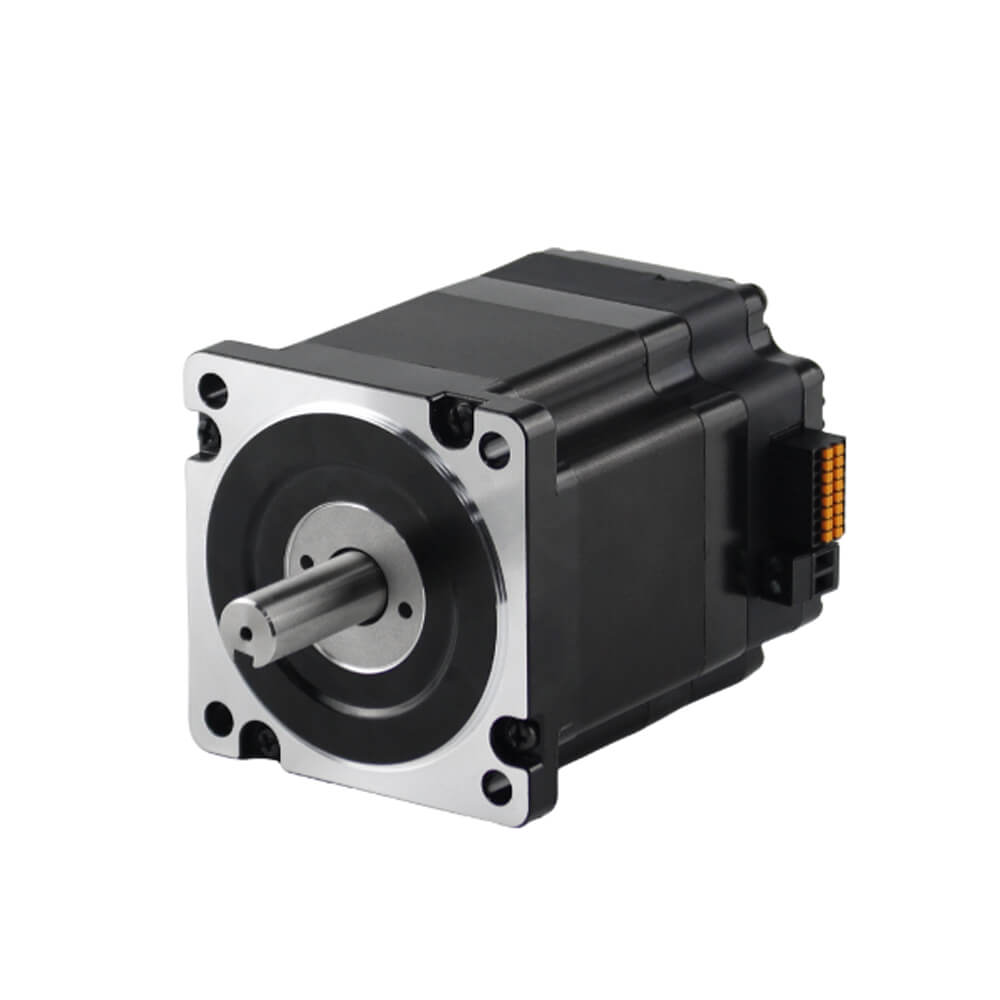
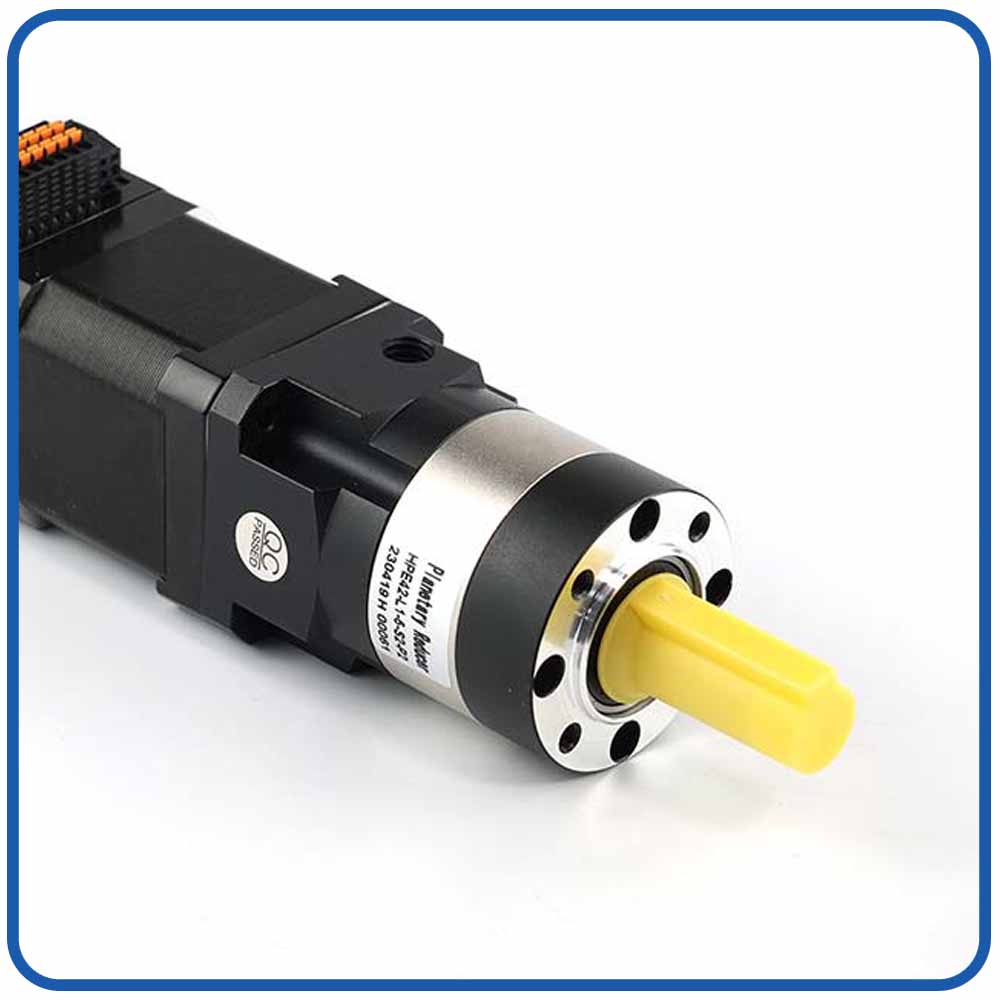
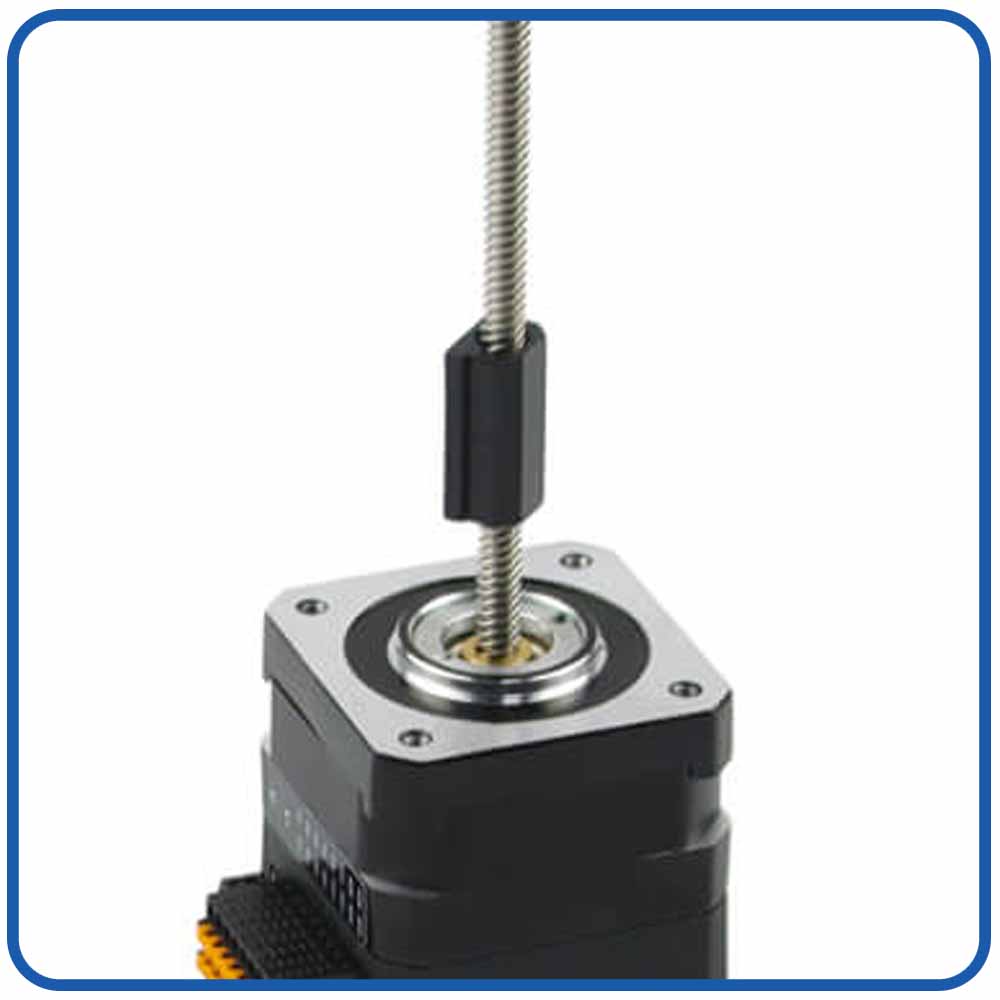
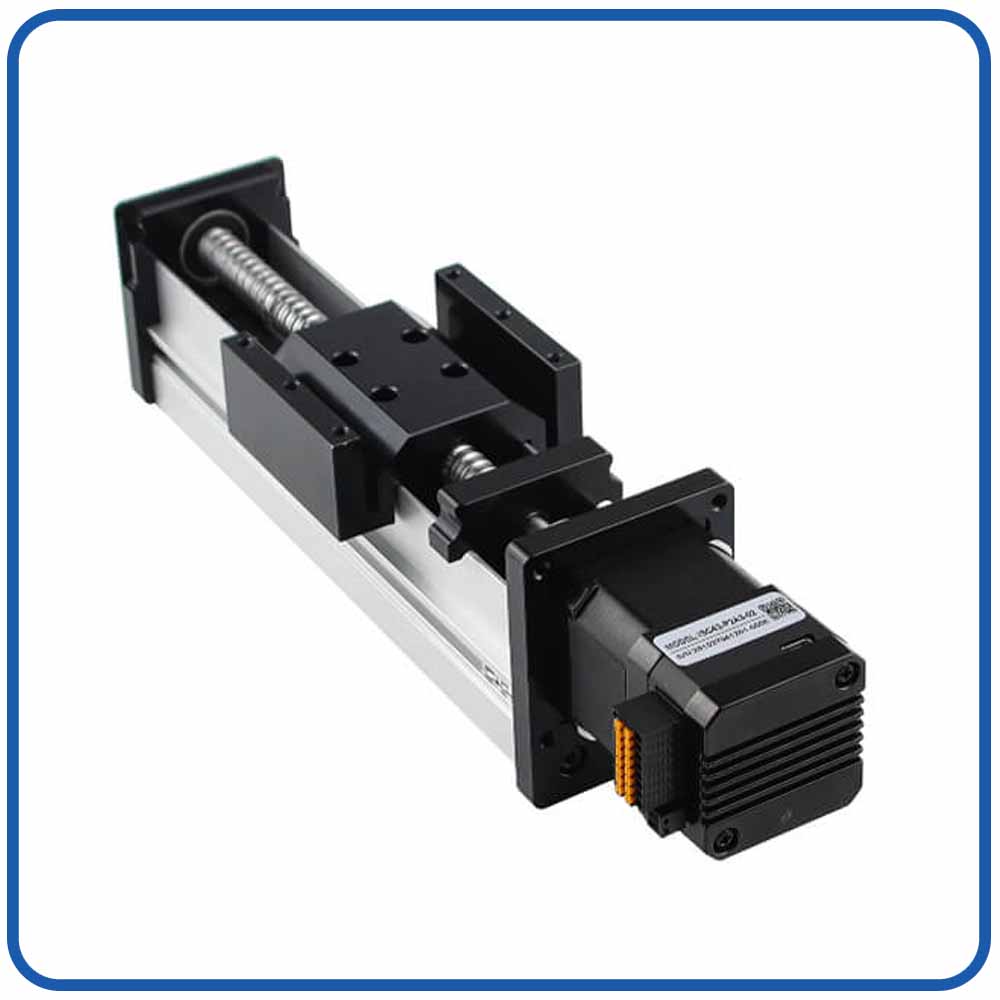
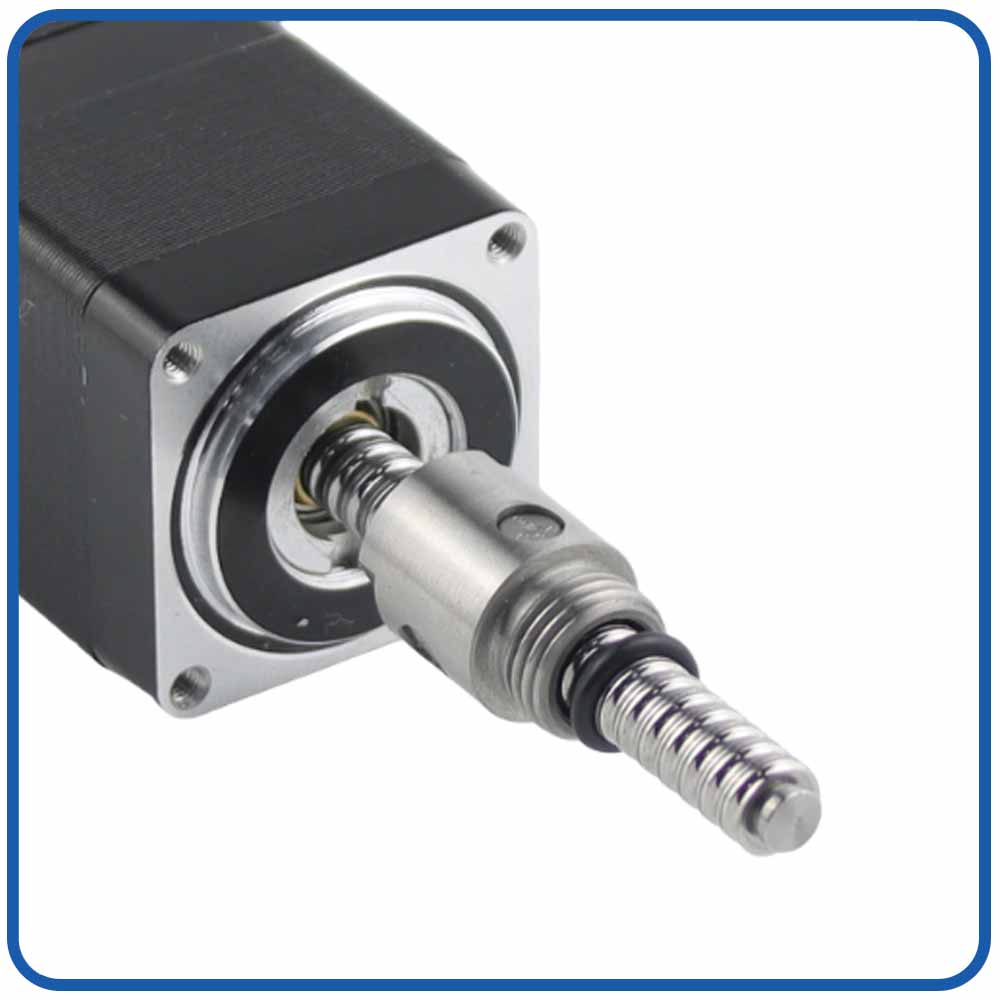
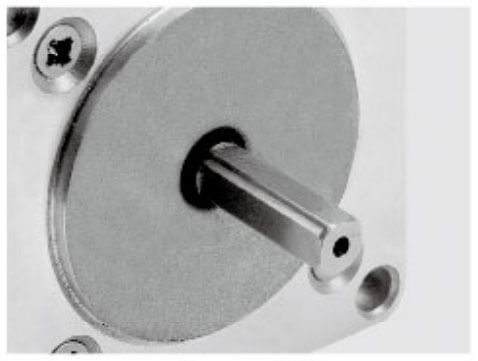
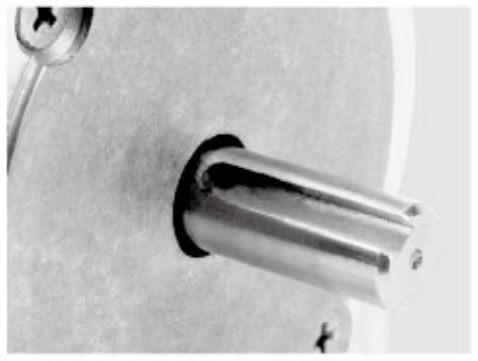
An integrated stepper servo motor for cutting machines combines a stepper motor, closed-loop feedback system, and motor driver into a compact motion-control unit. This integrated architecture provides accurate positioning, stable speed control, high torque at low and medium speeds, and reliable overload protection, making it suitable for a wide range of industrial cutting equipment.
Modern cutting machines require precise and repeatable motion. Whether the application involves paper cutting, textile cutting, leather cutting, packaging materials, foam, film, plastic sheets, or CNC knife cutting, the motor directly influences positioning accuracy, cutting quality, production speed, and machine reliability.
By integrating the motor, encoder, and driver into one unit, an integrated stepper servo motor can simplify machine design while reducing wiring, cabinet space, and commissioning complexity.
What Is an Integrated Stepper Servo Motor for a Cutting Machine?
An integrated stepper servo motor is a motion-control motor that combines several components into a single housing. A typical system includes:
Stepper motor
Closed-loop encoder
Integrated motor driver
Control electronics
Protection functions
Communication or pulse-and-direction interface
Unlike a conventional open-loop stepper motor, an integrated stepper servo motor uses encoder feedback to monitor the motor's actual position. The controller can therefore detect position errors and compensate for them during operation.
This closed-loop architecture is particularly valuable in cutting applications where the machine must repeatedly move a knife, blade, rotary cutter, feed roller, or positioning mechanism to a specific location.
How Does an Integrated Stepper Servo Motor Work in a Cutting Machine?
In a typical cutting machine, the motor controls the movement of a blade, cutting head, feed roller, conveyor, or positioning mechanism. The machine controller sends a motion command to the integrated motor, while the encoder simultaneously provides feedback about the motor's actual position and movement.
The integrated driver processes this information and regulates the motor accordingly.
This creates a closed-loop motion-control system that can provide:
Accurate positioning
Reliable speed control
Closed-loop feedback
Reduced risk of lost steps
Smooth acceleration and deceleration
Compact machine integration
Simplified wiring
For automated cutting applications, these characteristics are particularly useful because consistent positioning directly affects cutting dimensions, material alignment, productivity, and finished-product quality.
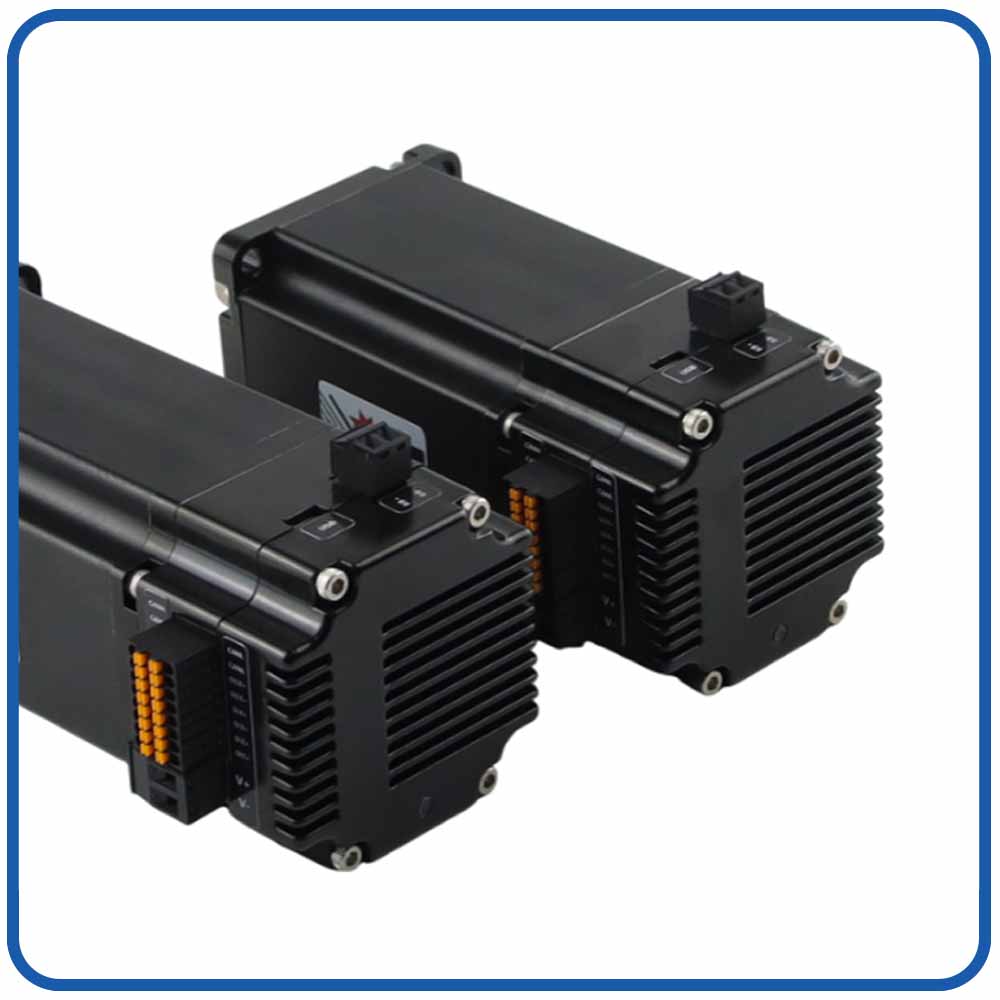
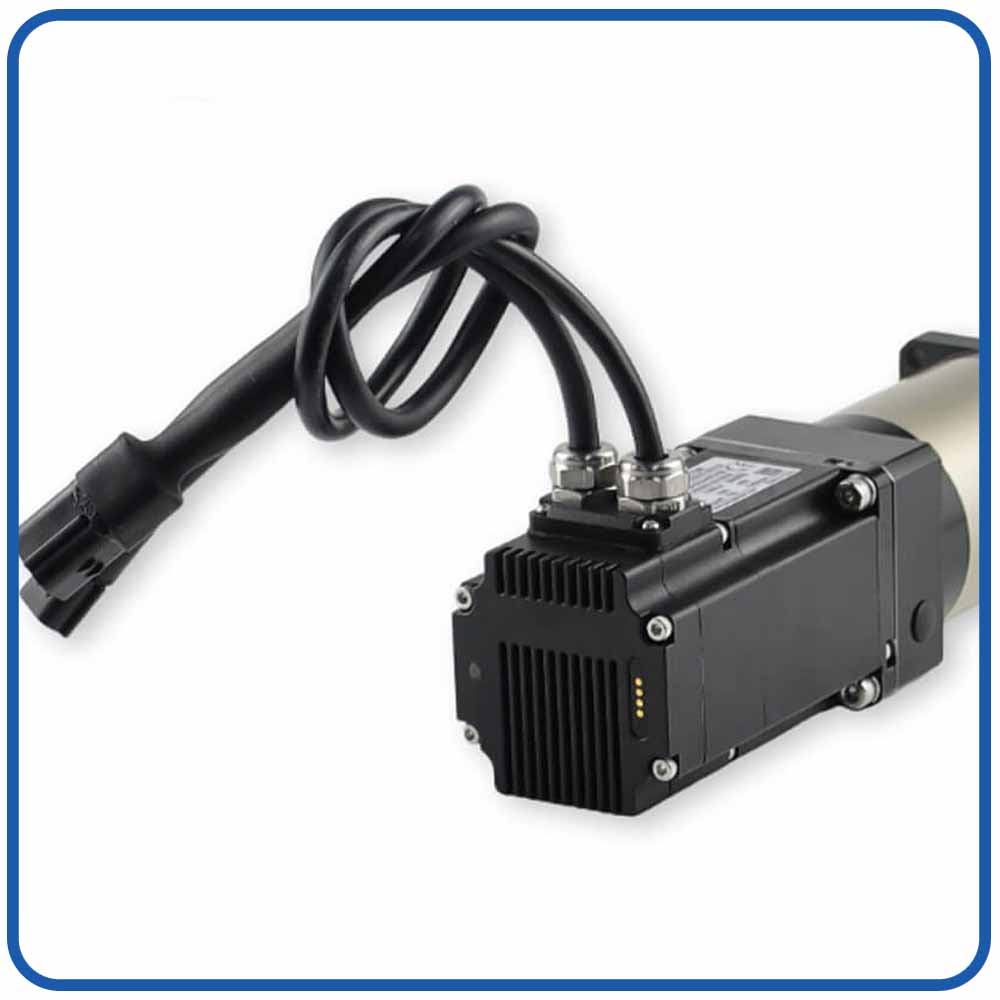
ISC86 Integrated Stepper Servo Motor — High-Efficiency, Compact, and Smart Closed-Loop Motion Control Solution
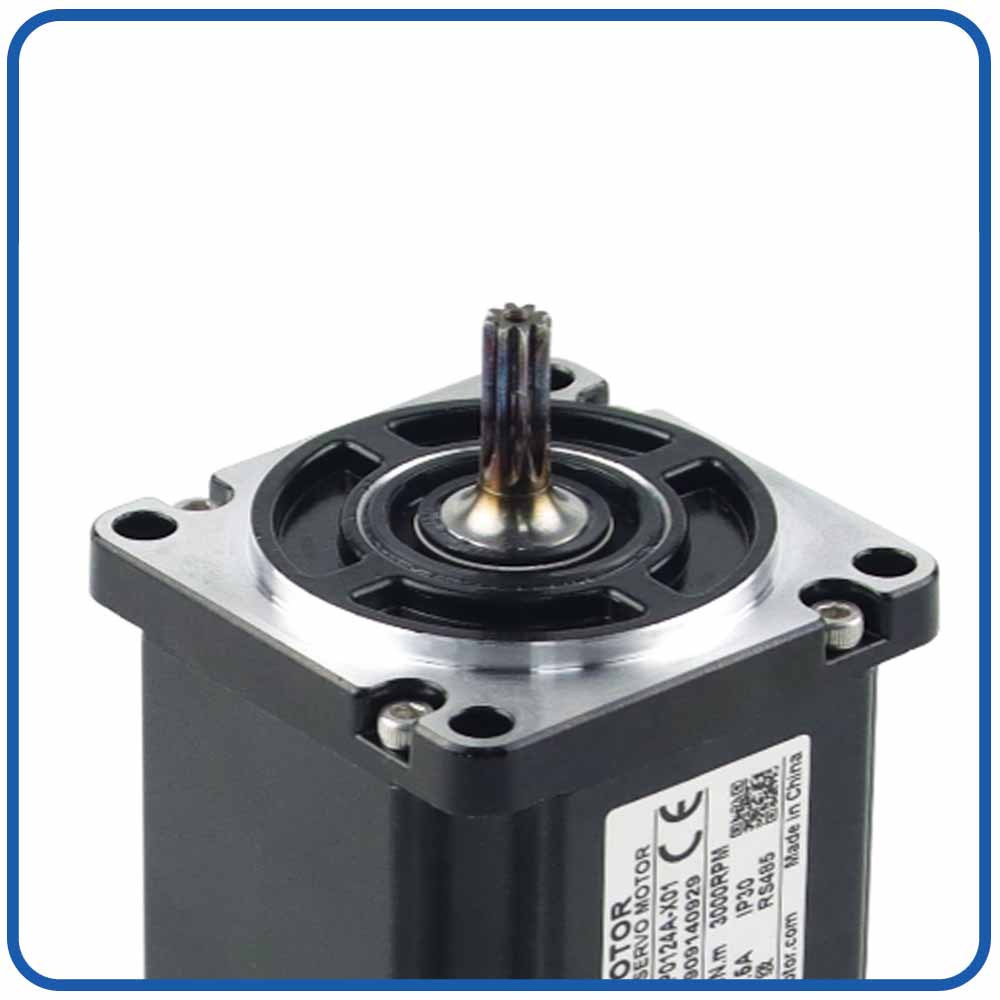
Product Overview:The NEMA 34 BFISC86 integrated stepper servo motor combines high-torque stepper performance, encoder feedback, and an integrated drive for precise, stable, and efficient industrial motion control.
Key Technical Highlights
High-Torque NEMA 34 Platform:
Designed around a large NEMA 34 frame, the BFISC86-P1A3 delivers strong torque output for demanding automation equipment requiring stable motion and reliable load handling.
Integrated Closed-Loop Control:
Encoder feedback continuously monitors motor position, enabling automatic error correction, improved positioning accuracy, and reduced risk of missed steps during dynamic or variable-load operation.
Integrated Drive Electronics:
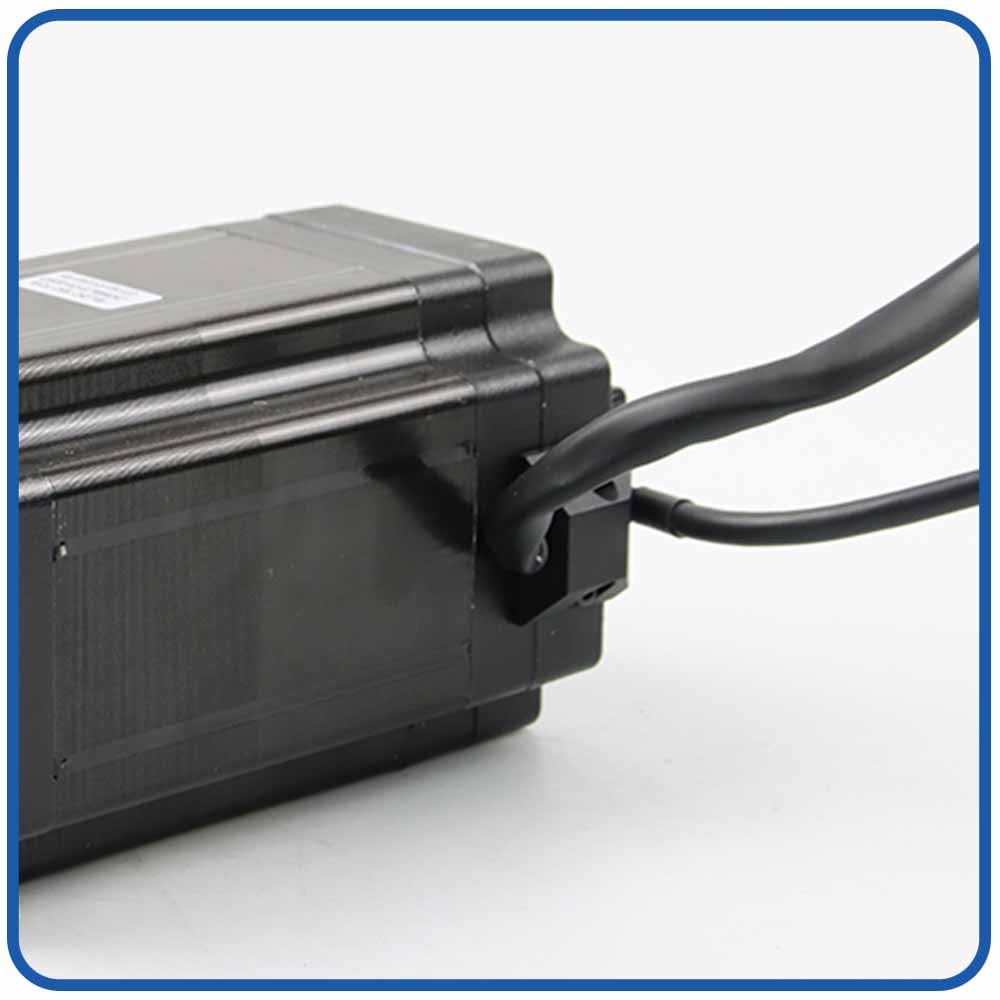
Motor, encoder, and driver are combined into one compact solution, reducing external components and wiring while simplifying machine architecture, installation, commissioning, and maintenance.
Precise Motion Performance:
Closed-loop stepper servo technology provides controlled acceleration, smooth operation, accurate positioning, and improved repeatability, making the motor suitable for precision-oriented industrial automation applications.
Typical Applications
CNC Machinery:
Provides reliable torque and precise positioning for CNC equipment, supporting coordinated axis movement, tool positioning, and demanding machining processes where stable closed-loop performance is required.
Industrial Automation Systems:
Suitable for conveyors, indexing mechanisms, robotic equipment, and automated production machinery requiring high torque, accurate positioning, and dependable motion control.
Packaging Machinery:
Supports precise feeding, indexing, cutting, and positioning operations in packaging equipment, helping maintain consistent machine cycles and reliable product handling at different operating speeds.
Textile and Printing Equipment:
Delivers controlled motion for textile machinery, printing systems, winding mechanisms, and other equipment requiring repeatable positioning, stable torque, and efficient integrated servo control.
ISC86 Series Key Specifications for Blood Analyzer
Cutting machines often perform repetitive positioning movements at relatively high frequency. The motion system must accelerate, decelerate, stop, reverse, and reposition accurately.
An integrated stepper servo motor for cutting machines offers several advantages.
1. High Positioning Accuracy
Accurate positioning is essential when cutting materials according to predefined dimensions. A small positioning error can result in incorrect cutting lengths, material waste, or inconsistent finished products.
Encoder feedback allows the integrated motor to monitor actual shaft movement and improve positioning reliability compared with traditional open-loop stepper systems.
2. Closed-Loop Operation
Traditional stepper motors can lose synchronism when overloaded or accelerated too aggressively. A closed-loop stepper servo motor continuously monitors motor position.
When an abnormal position deviation occurs, the control system can respond accordingly. This helps improve operational stability in demanding cutting applications.
3. High Torque at Low Speed
Many cutting mechanisms require substantial torque during acceleration, positioning, or blade engagement. Stepper motors naturally provide strong low-speed torque, making them suitable for applications requiring controlled and repeatable movement.
The integrated servo architecture combines this characteristic with feedback control, providing a practical solution for industrial motion systems.
4. Reduced Wiring
With the driver and feedback electronics integrated into the motor assembly, fewer external components may be required.
This can reduce:
Motor-driver wiring
Control cabinet space
Connector requirements
Installation time
Potential wiring errors
For compact cutting equipment, reducing the electrical footprint can simplify machine integration.
5. Simplified Machine Design
A conventional motion system may require a separate motor, driver, encoder connection, and associated wiring. An integrated stepper servo motor consolidates many of these components.
This allows machine designers to create a more compact and modular motion-control architecture.
Applications of Integrated Stepper Servo Motors in Cutting Machines
Integrated stepper servo motors can be used in multiple cutting and material-processing systems.
Paper and Cardboard Cutting Machines
Paper processing equipment requires accurate feeding and positioning. Integrated motors can drive feed rollers, cutting mechanisms, conveyors, and positioning axes.
Precise movement helps maintain consistent cutting lengths and alignment.
Textile Cutting Machines
Automated textile cutters require synchronized material feeding and cutting. Closed-loop stepper servo motors can provide controlled movement for fabric positioning systems and feed mechanisms.
Leather Cutting Machines
Leather cutting applications often require repeatable positioning because irregular material shapes make material utilization particularly important.
Accurate servo-controlled positioning can help improve cutting consistency and reduce unnecessary material loss.
CNC Knife Cutting Machines
CNC cutting systems may use multiple axes to control blade position. An integrated stepper servo motor can be used for X, Y, and Z-axis movement, depending on the machine architecture and required load.
Packaging Cutting Equipment
Packaging machines frequently combine feeding, indexing, sealing, and cutting processes. Integrated motors can control film feeding and positioning mechanisms while maintaining synchronization with the cutting cycle.
Foam and Flexible Material Cutting
Foam, rubber, film, and other flexible materials may require controlled feed rates and accurate positioning. Closed-loop motion control helps maintain repeatable movement throughout production.
Key Motor Parameters for Cutting Machine Applications
Selecting the correct integrated stepper servo motor requires more than simply matching the motor frame size. Several technical parameters should be evaluated.
Motor Frame Size
Common industrial stepper motor sizes include NEMA 11, NEMA 14, NEMA 17, NEMA 23, NEMA 24, NEMA 34, and larger frame sizes.
The appropriate size depends on the required torque, installation space, load inertia, acceleration, and mechanical transmission.
Rated Torque and Peak Torque
The required motor torque should include the load torque, friction, acceleration torque, transmission losses, and an appropriate engineering margin.
For cutting machines, insufficient torque can cause poor acceleration, vibration, positioning errors, or unexpected machine stoppage.
Speed Range
The required operating speed should be determined from the machine's actual production cycle.
For example, a feeding axis may require relatively high speed, while a cutting axis may prioritize controlled acceleration and precise positioning.
Motor torque generally changes with operating speed, so the manufacturer's torque-speed curve should be considered rather than relying solely on the motor's holding torque specification.
Encoder Resolution
Encoder resolution determines how accurately the control system can monitor motor position. A suitable encoder specification depends on the required positioning accuracy and application dynamics.
Supply Voltage
Integrated stepper servo motors are available with different supply-voltage configurations. Selecting an appropriate voltage helps ensure sufficient speed performance and electrical compatibility with the machine's power system.
Communication and Control Interface
Depending on the machine controller, the motor may support interfaces such as:
Pulse + Direction
RS-485
CANopen
EtherCAT
Other industrial communication protocols
The control interface should match the PLC, CNC controller, motion controller, or industrial computer used by the cutting machine.
Integrated Stepper Servo Motor vs. Traditional Stepper Motor
The primary difference is the feedback mechanism.
A conventional stepper motor normally operates in an open-loop configuration. The controller sends pulses based on the assumption that the motor follows the commanded position.
An integrated stepper servo motor adds encoder feedback and closed-loop control.
Feature
Traditional Stepper Motor
Integrated Stepper Servo Motor
Position feedback
Usually unavailable
Encoder feedback
Control
Open loop
Closed loop
Driver
Separate
Integrated
Wiring
More components
Simplified
Position error detection
Limited
Available
Overload response
May lose steps
Feedback-based correction
Cabinet space
Higher
Lower
System integration
More components
Compact architecture
For simple, low-cost positioning applications, a conventional stepper motor can still be appropriate. For cutting machines where repeatability, reliability, and motion stability are important, an integrated stepper servo motor can provide additional advantages.
How to Select the Right Integrated Stepper Servo Motor for a Cutting Machine
Selecting the right integrated stepper servo motor for a cutting machine requires matching the motor to the machine's load, speed, accuracy, and control requirements. The following factors should be evaluated before choosing a model.
1. Determine the Required Torque
Calculate the torque required to move the cutting head, blade, feed roller, or positioning mechanism. Consider load weight, friction, acceleration, transmission efficiency, and mechanical resistance.
Choose a motor with sufficient torque margin to maintain reliable operation under peak loads.
2. Check the Required Speed
Determine the machine's maximum operating speed and acceleration rate. Motor torque decreases as speed increases, so always check the manufacturer's torque-speed curve rather than selecting a motor based only on holding torque.
3. Consider Positioning Accuracy
Cutting machines often require precise and repeatable positioning. An integrated stepper servo motor with encoder feedback can monitor actual motor movement and help compensate for position deviations.
For high-precision cutting, also consider the accuracy and backlash of the screw, belt, gearbox, or other transmission system.
4. Select the Appropriate Motor Size
Common frame sizes include NEMA 17, NEMA 23, NEMA 24, and NEMA 34. The correct size depends on required torque, installation space, load inertia, and machine structure.
A larger motor is not automatically better; the motor should be correctly matched to the complete motion system.
5. Verify the Control Interface
Make sure the integrated motor is compatible with the machine controller or PLC. Depending on the model, control options may include Pulse/Direction, RS-485, CANopen, or EtherCAT.
6. Consider the Working Environment
Evaluate temperature, dust, vibration, humidity, and continuous operating conditions. The motor's protection rating, thermal performance, and duty capability should meet the requirements of the cutting machine.
7. Evaluate the Complete Motion System
Motor selection should also account for the mechanical transmission, including:
Ball screws
Lead screws
Timing belts
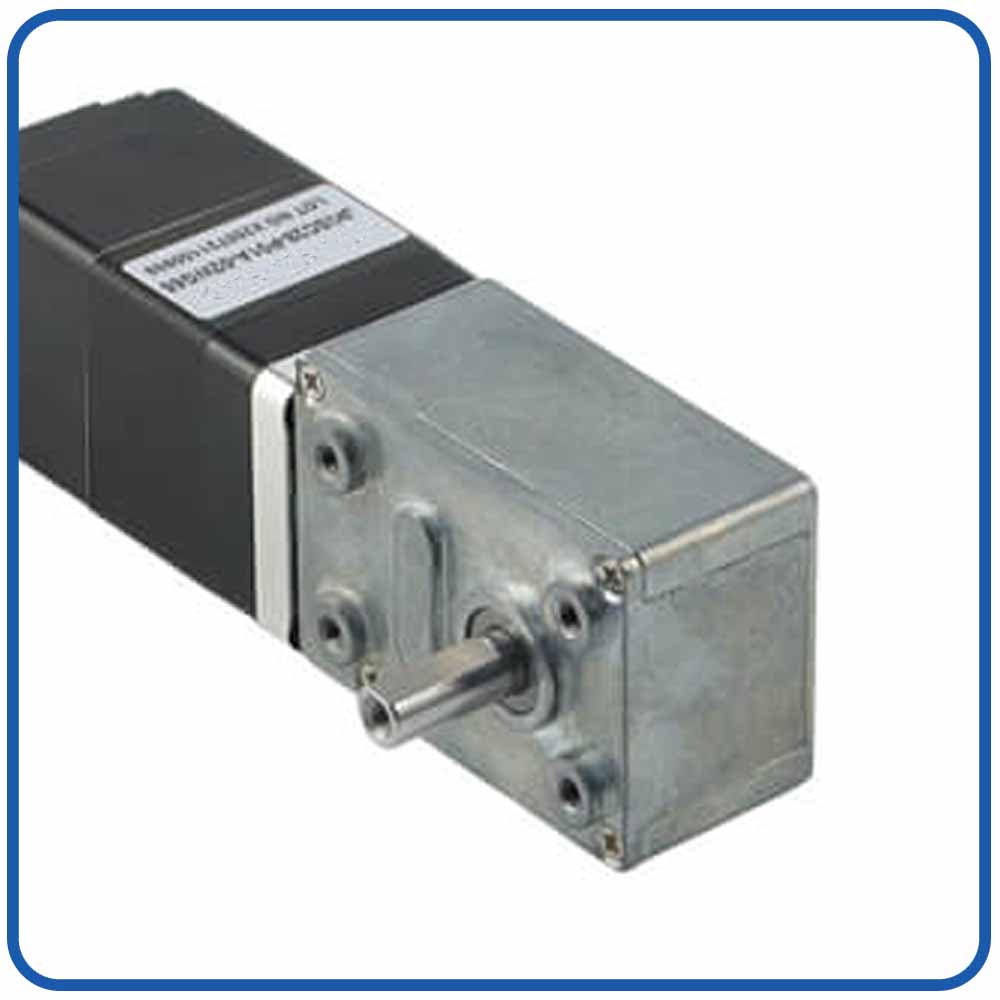
Gearboxes
Rack-and-pinion systems
Direct-drive mechanisms
A properly selected motor combined with a low-backlash transmission can deliver better positioning accuracy and cutting consistency.
Summary
The right integrated stepper servo motor for a cutting machine should provide adequate torque, speed, positioning accuracy, encoder feedback, and controller compatibility. By matching these specifications to the actual mechanical and operating requirements, we can achieve stable motion, reliable positioning, and consistent cutting performance.
Mechanical Transmission Considerations
The motor is only one part of the cutting machine's motion system. The transmission mechanism has a major effect on overall performance.
Common mechanisms include:
Ball screws
Lead screws
Timing belts
Gearboxes
Rack-and-pinion systems
Direct-drive mechanisms
Roller feeding systems
For applications requiring high positioning accuracy, a low-backlash transmission is particularly important.
A high-performance motor cannot fully compensate for excessive mechanical backlash, poor alignment, flexible couplings, or inadequate machine rigidity.
Acceleration and Deceleration in Cutting Applications
Cutting machines frequently operate with repeated start-stop motion. This makes acceleration and deceleration profiles important.
An overly aggressive acceleration profile can increase vibration and mechanical stress. An excessively slow profile can reduce production efficiency.
The integrated stepper servo motor should therefore be configured with an appropriate acceleration curve based on:
Load inertia
Motor torque
Transmission ratio
Machine rigidity
Required cycle time
Material characteristics
Optimized motion profiles can improve both cutting accuracy and machine productivity.
Benefits for OEM Cutting Machine Manufacturers
For OEMs, an integrated stepper servo motor can simplify machine design while providing reliable motion control. The main benefits include:
1. Compact Machine Design
The motor, driver, and encoder are integrated into one unit, helping reduce the space required for electrical components and making compact cutting machines easier to design.
2. Simplified Wiring
Fewer external components and shorter wiring connections can make installation, commissioning, and maintenance more straightforward.
3. Lower System Complexity
An integrated solution reduces the need to separately select and configure a motor, driver, and encoder, helping OEM engineers streamline machine development.
4. Reliable Closed-Loop Motion
Encoder feedback allows the system to monitor motor position and detect movement deviations, supporting stable and repeatable cutting operations.
5. Flexible Machine Integration
Integrated stepper servo motors can be used for cutting heads, feeding systems, indexing mechanisms, and positioning axes, depending on the machine configuration.
6. Easier Product Standardization
OEM manufacturers can use standardized integrated motor platforms across different machine models, simplifying procurement, assembly, and maintenance.
7. Improved Cutting Performance
With accurate positioning and controlled acceleration, the motor can help achieve consistent feeding, precise cutting, and reliable repetitive operation, supporting higher machine productivity.
Overall, an integrated stepper servo motor offers OEM cutting-machine manufacturers a compact, simplified, and reliable motion-control solution while helping reduce system complexity and improve machine integration.
Installation and Maintenance Considerations
Correct mechanical installation is essential for achieving reliable performance.
The motor should be mounted securely, with proper shaft alignment and suitable coupling selection. Excessive radial or axial loading should be avoided unless the motor is specifically designed to handle it.
Electrical connections should follow the manufacturer's wiring requirements. Appropriate grounding, shielding, and cable routing can help reduce electromagnetic interference in industrial environments.
Regular inspection should include:
Motor mounting
Coupling condition
Cable connections
Mechanical transmission
Excessive vibration
Unusual noise
Temperature
Encoder feedback
Error or alarm conditions
Preventive maintenance can help reduce unexpected downtime in continuous-production cutting systems.
Future of Integrated Servo Motion in Cutting Equipment
As cutting machines become increasingly automated, motion systems are expected to provide greater precision, connectivity, and diagnostic capability.
Integrated stepper servo motors can support this trend by combining motor power, feedback, and control electronics into a compact unit.
For manufacturers developing smart cutting machines, CNC equipment, automated feeding systems, and intelligent material-processing equipment, integrated motion solutions can provide a practical route toward more compact and digitally connected machine architectures.
Conclusion
An integrated stepper servo motor for cutting machines provides a combination of accurate positioning, closed-loop feedback, strong low-speed torque, compact construction, and simplified wiring. These characteristics make it suitable for paper cutters, textile cutters, leather cutting machines, CNC knife systems, packaging equipment, foam cutters, and other automated material-processing machinery.
The correct motor should be selected according to the complete motion profile, including torque, speed, acceleration, load inertia, positioning accuracy, transmission mechanism, duty cycle, power supply, and controller compatibility.
When properly matched with the mechanical system and motion controller, an integrated stepper servo motor can help cutting-machine manufacturers achieve stable motion, repeatable positioning, reduced system complexity, and reliable automated production.
FAQ:
1. What is an integrated stepper servo motor for a cutting machine?
An integrated stepper servo motor combines a stepper motor, encoder, and driver in one unit, providing closed-loop motion control for accurate positioning and reliable cutting-machine operation.
2. Why use an integrated stepper servo motor in a cutting machine?
It simplifies the motion-control system by integrating key components, reducing wiring and installation complexity while providing feedback-based positioning control for cutting, feeding, indexing, and related operations.
3. How does closed-loop control improve cutting-machine performance?
Encoder feedback monitors motor movement and helps detect positioning errors, allowing the control system to respond to deviations and improve positioning reliability during repeated cutting operations.
4. What cutting machines can use an integrated stepper servo motor?
These motors can be used in various automated cutting machines, including industrial cutters, fabric cutters, paper cutters, film-cutting equipment, labeling systems, and other precision positioning machinery.
5. Can an integrated stepper servo motor improve cutting accuracy?
It can help improve positioning accuracy and repeatability because encoder feedback enables the system to monitor actual motor movement rather than relying solely on open-loop step commands.
6. Does an integrated stepper servo motor reduce machine wiring?
Yes. Integrating the motor, encoder, and driver into one assembly can reduce external wiring and component count, helping create a cleaner and more compact cutting-machine motion system.
7. Is an integrated stepper servo motor suitable for high-speed cutting applications?
Suitability depends on the machine's required speed, torque, acceleration, load, and control requirements. Proper motor sizing is essential to maintain stable positioning during high-speed cutting cycles.
8. How do I select an integrated stepper servo motor for a cutting machine?
Consider required torque, speed, acceleration, load inertia, positioning accuracy, duty cycle, power supply, encoder requirements, mounting dimensions, and communication or control interface before selecting a motor.
9. What are the advantages for cutting-machine OEM manufacturers?
An integrated stepper servo motor can simplify machine architecture, reduce external components, streamline wiring, and shorten installation time, helping OEMs develop more compact and standardized motion-control solutions.
10. What should be considered when integrating the motor into a cutting machine?
Engineers should evaluate mechanical load, transmission ratio, acceleration, operating speed, duty cycle, control signals, installation space, thermal conditions, and required positioning performance to ensure proper system compatibility.

 English
 العربية
 Français
 Русский
 Español
 Português
 Deutsch
 italiano
 日本語
日本語 한국어
한국어 Nederlands
 Tiếng Việt
 ไทย
ไทย Polski
 Türkçe
 ພາສາລາວ
 ភាសាខ្មែរ
 Bahasa Melayu
 ဗမာစာ
ဗမာစာ Filipino
 Bahasa Indonesia
 magyar
 Română
 Čeština
 Монгол
 қазақ
қазақ Српски
 हिन्दी
 فارسی
فارسی Slovenčina
 Slovenščina
 Norsk
Norsk Svenska
 українська
 Ελληνικά
 Suomi
Suomi Հայերեն
 עברית
עברית Latine
 Dansk
Dansk Shqip
Shqip বাংলা
বাংলা Hrvatski
 Afrikaans
 Gaeilge
 Eesti keel
 Oʻzbekcha
 latviešu
 Azərbaycan dili
 Български
 Català