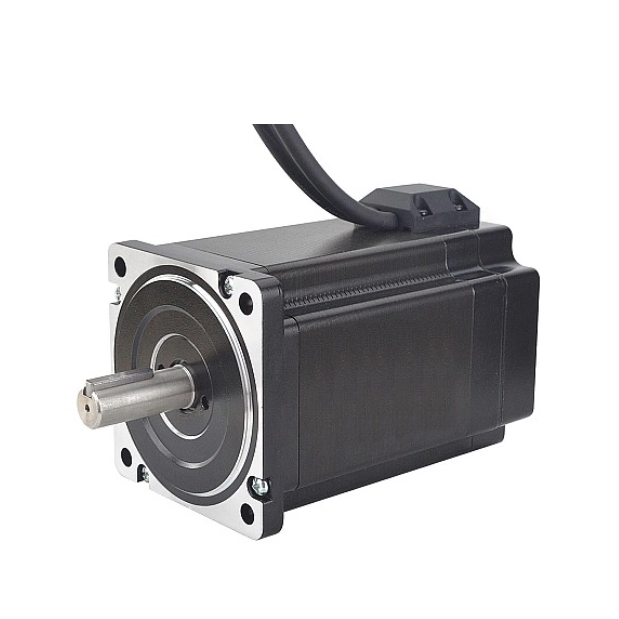
Introduction to Stepper Motor Control Architectures
Stepper motors remain a cornerstone in modern motion control systems due to their precise positioning, repeatable motion, and cost-efficient control structure. As industrial automation, medical devices, robotics, and semiconductor equipment continue to demand higher accuracy and reliability, a key decision repeatedly emerges: Should a stepper motor operate with an encoder or without one?
We address this question by comparing open-loop stepper motors (without encoders) and closed-loop stepper motors (with encoders), analyzing when feedback becomes essential and how it impacts system performance, cost, and long-term reliability.
Understanding Stepper Motors Without Encoders (Open-Loop Systems)
How Open-Loop Stepper Motors Work
A stepper motor without an encoder operates in an open-loop control system, meaning the controller sends command pulses assuming the motor follows them exactly. Each pulse corresponds to a fixed angular step, enabling predictable positioning without feedback.
Key Advantages of Open-Loop Stepper Motors
Lower system cost due to the absence of feedback devices
Simple architecture with minimal wiring and configuration
High holding torque at standstill
Reliable performance in stable, low-load environments
These motors are ideal where motion profiles are predictable and external disturbances are minimal.
Limitations of Open-Loop Control
Despite their simplicity, open-loop stepper motors cannot detect:
When torque demand exceeds available motor torque, the motor may stall silently, resulting in position loss without system awareness.
Stepper Motors with Encoders (Closed-Loop Systems Explained)
What an Encoder Adds to a Stepper Motor
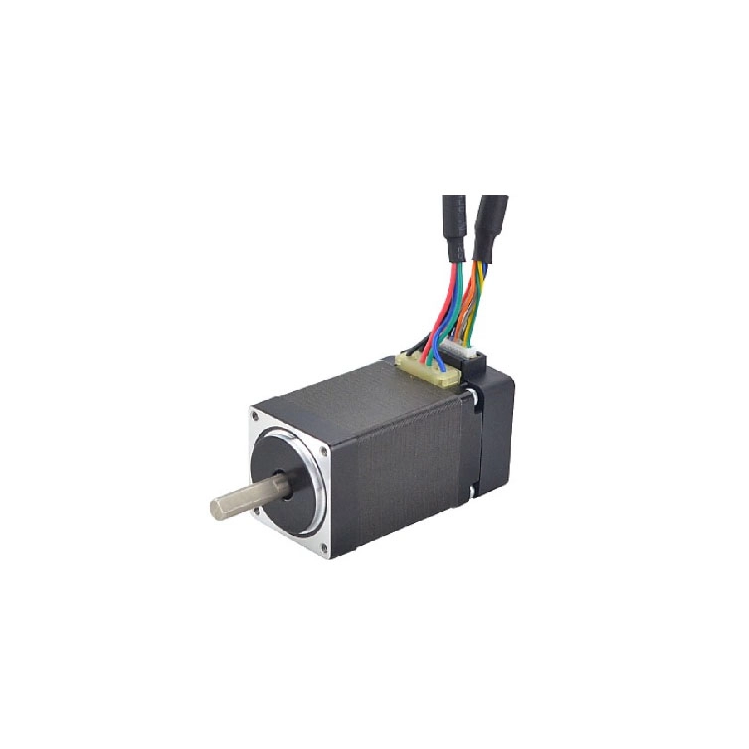
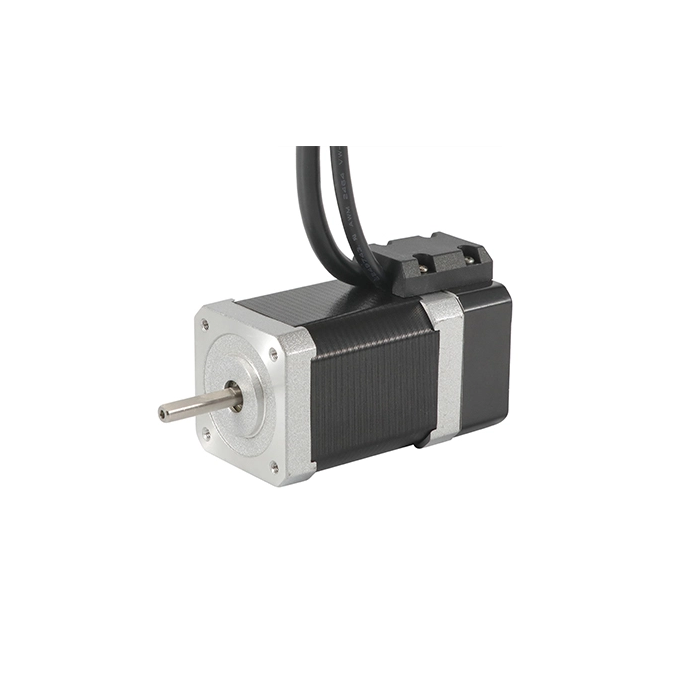
A stepper motor with encoder integrates position or speed feedback, typically via optical or magnetic encoders. This feedback allows the controller to verify actual rotor position in real time.
How Closed-Loop Stepper Systems Operate
Closed-loop stepper motors continuously compare:
Commanded position
Actual motor position
If deviation occurs, the system automatically compensates by adjusting current, speed, or torque, maintaining precise motion.
Elimination of lost steps
Higher usable torque across speed ranges
Reduced motor heating
Improved dynamic response
Fault detection and alarms
These advantages make encoder-equipped stepper motors suitable for mission-critical applications.
Accuracy and Positioning Reliability Comparison
Accuracy and positioning reliability are decisive criteria when selecting between a stepper motor with encoder and a stepper motor without encoder. While both configurations are capable of precise motion under the right conditions, their performance diverges significantly when real-world variables are introduced.
Open-Loop Stepper Motors: Theoretical Accuracy Without Verification
Stepper motors operating without an encoder rely entirely on commanded step counts to determine position. Each electrical pulse corresponds to a fixed mechanical step, which creates excellent theoretical positioning accuracy under ideal conditions. In applications with stable loads, low speeds, and conservative acceleration, this approach can deliver repeatable results.
However, the absence of feedback means the system assumes the motor has executed every step correctly. If any of the following occur, accuracy is immediately compromised without detection:
Sudden load increase
Mechanical friction or wear
Acceleration beyond torque capability
Resonance or vibration
Power supply fluctuations
Once a step is missed, all subsequent positions are offset, leading to cumulative positioning error. The system continues operating unaware of the deviation, which can result in product defects, alignment errors, or process failure.
Closed-Loop Stepper Motors: Verified and Corrected Positioning
A stepper motor with an encoder operates in a closed-loop control system, continuously comparing actual rotor position with the commanded position. This real-time feedback transforms accuracy from a calculated assumption into a measured and enforced parameter.
If positional deviation is detected, the controller immediately compensates by adjusting current, torque, or speed. This ensures:
No accumulated position error
Automatic correction of missed steps
Consistent accuracy across long motion cycles
Encoders enable the system to maintain precision even under changing loads, dynamic motion profiles, or external disturbances.
Repeatability vs Absolute Accuracy
In precision-driven environments, such as CNC machining, semiconductor handling, or medical positioning systems, absolute accuracy is critical. Closed-loop stepper motors provide this accuracy by continuously validating motion.
Long-Term Reliability and Drift Prevention
Over time, mechanical components inevitably experience wear. In open-loop systems, this leads to gradual positioning drift that is difficult to diagnose. Closed-loop systems detect and compensate for these changes instantly, preserving accuracy throughout the motor's service life.
Summary of Accuracy Performance
| Control Method | Accuracy Assurance | Error Detection | Drift Prevention |
| Stepper without Encoder | Assumed | None | No |
| Stepper with Encoder | Verified | Real-time | Yes |
In environments where precision, consistency, and fault tolerance are non-negotiable, encoder feedback is not an enhancement—it is a necessity. Closed-loop stepper motors deliver a level of positioning reliability that open-loop systems cannot sustain under real operating conditions.
Torque Utilization and Efficiency Differences
Open-Loop Torque Constraints
Without feedback, motors must be oversized to prevent stalling. This leads to:
Closed-Loop Torque Optimization
Encoders allow motors to:
Deliver torque only when needed
Dynamically adjust current
Maintain efficiency under varying loads
This results in smaller motor sizes, lower power draw, and longer service life.
Speed Performance and Dynamic Behavior
Open-Loop Speed Limitations
Stepper motors without encoders may experience:
Closed-Loop High-Speed Stability
Encoder feedback enables:
This makes closed-loop stepper motors a strong alternative to servo motors in many systems.
System Cost and Complexity Considerations
Initial Cost Comparison
Open-loop stepper motors have lower upfront costs
Closed-loop stepper motors include encoders, advanced drivers, and more complex control logic
Total Cost of Ownership
While encoder-equipped systems cost more initially, they often reduce:
Scrap rates
Downtime
Maintenance costs
Field failures
For high-value production environments, closed-loop systems deliver superior ROI.
When Is Encoder Feedback Necessary?
Applications That Require Encoders
Encoder feedback becomes essential in scenarios involving:
Variable or unknown loads
High-speed motion with frequent acceleration
Long travel distances
Critical positioning accuracy
Continuous or unattended operation
Typical applications include:
CNC machines
Robotic arms
Medical imaging equipment
Semiconductor manufacturing tools
Automated inspection systems
When Open-Loop Stepper Motors Are Sufficient
Open-loop stepper motors remain effective for:
When loads are stable and cost efficiency is paramount, open-loop systems remain a practical choice.
Reliability and Fault Handling
Open-Loop Risk Profile
Open-loop systems cannot self-diagnose faults. Position errors may go unnoticed until product quality is compromised.
Closed-Loop Predictive Reliability
Encoders enable:
Error detection
Stall warnings
Real-time diagnostics
This significantly improves system reliability and operational safety.
Stepper Motor with Encoder vs Servo Motor
The comparison between a stepper motor with encoder and a servo motor is increasingly relevant as closed-loop stepper technology continues to evolve. Both solutions offer feedback-controlled motion, yet they differ significantly in control philosophy, performance characteristics, system complexity, and cost. Selecting the optimal solution depends on application demands rather than headline specifications.
Control Principle and Operating Behavior
A stepper motor with encoder operates on a closed-loop stepper control architecture, where motion is still executed in discrete steps, but real-time feedback verifies that each commanded step is achieved. If positional deviation occurs, the controller compensates by increasing torque or correcting position.
A servo motor, by contrast, operates on a continuous closed-loop control system, using encoder or resolver feedback to constantly regulate speed, torque, and position. The motor rotates smoothly without discrete step increments, allowing for extremely fine motion resolution.
Positioning Accuracy and Resolution
Stepper Motor with Encoder:
Achieves high positioning accuracy by verifying step execution. Microstepping combined with encoder feedback delivers excellent resolution, particularly in low- to mid-speed positioning tasks.
Servo Motor:
Offers superior absolute positioning accuracy and ultra-fine resolution across the full speed range, making it ideal for complex interpolation and contouring applications.
For most industrial positioning tasks, closed-loop steppers deliver more than sufficient accuracy without servo-level complexity.
Torque Characteristics and Holding Performance
Stepper motors with encoders provide high holding torque at standstill without requiring continuous motion correction. This makes them highly efficient for vertical axes or static positioning.
Servo motors generate torque dynamically and typically require active current control to maintain position, resulting in continuous energy consumption even when stationary.
Speed Range and Dynamic Response
Servo motors excel in high-speed, high-acceleration environments, maintaining torque consistency across a wide speed range. They are well suited for demanding motion profiles involving rapid direction changes and continuous operation.
Closed-loop stepper motors perform exceptionally well at low to medium speeds. While modern designs significantly extend usable speed ranges, servo motors retain an advantage in extreme dynamic applications.
Stability and Resonance Behavior
Stepper motors without feedback are prone to resonance, but encoder-equipped steppers effectively suppress this issue through active correction. As a result, closed-loop steppers operate with smooth motion and reduced vibration.
Servo motors inherently avoid resonance due to continuous feedback control, offering exceptionally smooth and stable motion even under aggressive operating conditions.
System Complexity and Setup
For integrators seeking fast deployment and predictable behavior, closed-loop steppers provide a clear advantage.
Cost and Total Ownership Considerations
Stepper motors with encoders are significantly more cost-effective than servo systems. They require simpler drives, less advanced controllers, and reduced engineering time.
Servo systems carry higher initial costs and maintenance complexity but deliver unmatched performance in highly dynamic or precision-critical environments.
Energy Efficiency and Thermal Management
Closed-loop stepper motors adjust current dynamically based on load, reducing heat generation and improving efficiency. Their high holding torque also minimizes energy usage in static positions.
Servo motors consume continuous power to maintain position, which can increase thermal load and energy costs in applications with frequent stops.
Application Suitability Comparison
| Application Type | Closed-Loop Stepper | Servo Motor |
| CNC Routers | ✔ | ✔ |
| Robotics | ✔ | ✔✔ |
| Packaging Machinery | ✔✔ | ✔ |
| Semiconductor Equipment | ✔ | ✔✔ |
| Medical Devices | ✔✔ | ✔ |
| High-Speed Automation | ✔ | ✔✔ |
Decision Guidance
A stepper motor with encoder is the optimal choice when:
Cost efficiency is a priority
High holding torque is required
Motion profiles are predictable
Simple setup and reliability are critical
A servo motor is preferable when:
Extreme speed and acceleration are required
Continuous motion with complex trajectories is involved
Ultra-high precision under dynamic loads is mandatory
Conclusion
Stepper motors with encoders bridge the gap between traditional open-loop steppers and full servo systems. They deliver verified positioning, high efficiency, and simplified control at a fraction of the cost and complexity of servo motors. For many modern motion control applications, closed-loop stepper motors provide the ideal balance between performance and practicality, while servo motors remain the solution of choice for the most demanding dynamic environments.
Environmental and Mechanical Considerations
Encoders can be selected to withstand:
With proper enclosure and encoder selection, closed-loop stepper motors maintain performance even in harsh industrial settings.
Final Decision Framework
When choosing between a stepper motor with encoder and one without, we recommend evaluating:
Encoder feedback is not universally required, but in high-performance and high-reliability systems, it becomes a strategic advantage rather than an optional feature.
Conclusion
Stepper motors without encoders continue to serve reliably in cost-sensitive and stable-load applications. However, as automation systems evolve toward greater precision, speed, and intelligence, stepper motors with encoders provide unmatched control confidence. By enabling real-time feedback, fault detection, and efficiency optimization, closed-loop stepper motors represent a future-ready solution for demanding motion control environments.

 English
 العربية
 Français
 Русский
 Español
 Português
 Deutsch
 italiano
 日本語
日本語 한국어
한국어 Nederlands
 Tiếng Việt
 ไทย
ไทย Polski
 Türkçe
 ພາສາລາວ
 ភាសាខ្មែរ
 Bahasa Melayu
 ဗမာစာ
ဗမာစာ Filipino
 Bahasa Indonesia
 magyar
 Română
 Čeština
 Монгол
 қазақ
қазақ Српски
 हिन्दी
 فارسی
فارسی Slovenčina
 Slovenščina
 Norsk
Norsk Svenska
 українська
 Ελληνικά
 Suomi
Suomi Հայերեն
 עברית
עברית Latine
 Dansk
Dansk Shqip
Shqip বাংলা
বাংলা Hrvatski
 Afrikaans
 Gaeilge
 Eesti keel
 Oʻzbekcha
 latviešu
 Azərbaycan dili
 Български
 Català