Introduction: The Rising Demand for High-Efficiency Palletizing Automation
Modern industrial automation is rapidly evolving, and palletizing systems have become a critical component in high-throughput manufacturing and logistics environments. As production speeds increase and labor shortages persist, industries are turning to advanced motion control solutions to improve reliability, precision, and operational efficiency.
Among the most impactful innovations is the adoption of integrated DC servo motors, which combine motor, drive, encoder, and control electronics into a compact, intelligent unit. We see these systems widely implemented in palletizing robots, robotic arms, and automated stacking lines due to their ability to deliver high torque density, precise motion control, and energy-efficient operation.
In this article, we explore why integrated DC servo motors are the preferred choice for palletizing systems and how they significantly enhance overall system performance.
Understanding Integrated DC Servo Motors in Palletizing Systems
An integrated DC servo motor is a compact motion solution that unifies multiple components into a single housing:
Brushless DC motor (BLDC core)
Servo drive electronics
Encoder feedback system
Motion control algorithms
In palletizing systems, this integration eliminates the need for external drives and complex wiring, enabling a more streamlined and reliable architecture.
Palletizing applications demand synchronized multi-axis movement, often handling heavy loads at high speed. Integrated DC servo motors provide the responsiveness and control accuracy necessary for:
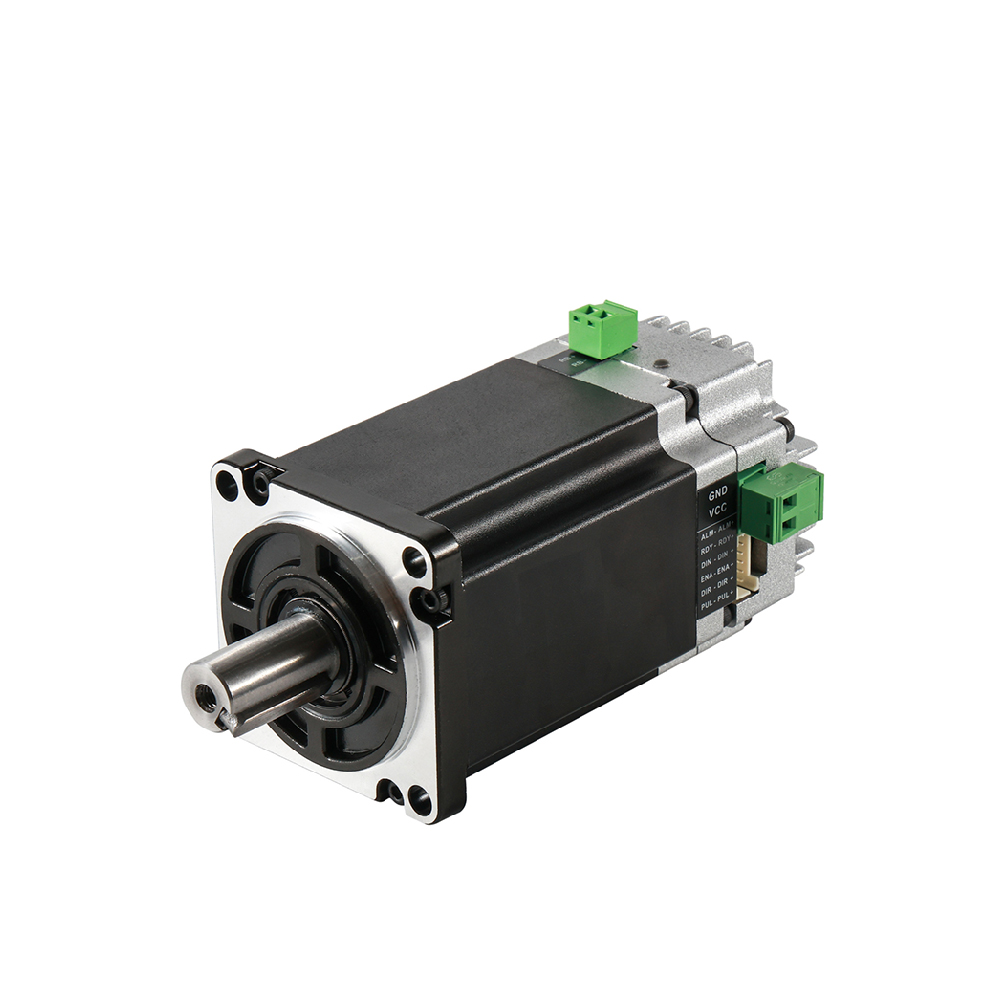
IDC60 Integrated BLDC Servo Motor — High-Efficiency, Compact, and Smart Closed-Loop Motion Control Solution
Product Overview:The IDS60 integrated BLDC servo motor from Besfoc is a compact NEMA 24 solution combining motor, drive, and encoder in one unit. It provides precise closed-loop control, stable torque, and fast response. Its integrated design reduces wiring, saves space.
Key Technical Highlights
Integrated All-in-One Design Combines BLDC motor, servo drive, and encoder in a compact unit, reducing wiring complexity and improving installation efficiency.
High-Precision Closed-Loop Control Ensures accurate position, speed, and torque regulation with real-time feedback for stable and smooth motion performance.
Powerful Modular Customization (OEM/ODM) Supports flexible customization options, including voltage, torque, communication protocols, and encoder resolution to meet diverse application requirements.
High Efficiency & Compact Structure Delivers strong torque density with optimized thermal performance, making it ideal for space-limited automation and robotics systems.
Typical Applications
Pipeline Inspection Robots Provides stable low-speed torque and precise motion control for navigating narrow, curved, and complex pipeline environments.
Automated Guided Vehicles (AGVs) Ensures smooth acceleration, accurate positioning, and reliable operation in logistics and smart warehouse systems.
Robotic Automation Systems Ideal for robotic arms, grippers, and compact motion modules requiring high precision and fast response.
Smart Manufacturing Equipment Supports high-accuracy motion control in assembly lines, packaging machines, and precision industrial automation devices.
IDS60 Series Integrated Brushless Dc Motor Parameters
Why High Efficiency Matters in Palletizing Automation
High efficiency is a fundamental requirement in modern palletizing automation systems, where speed, accuracy, and continuous operation directly determine production profitability. As warehouses, manufacturing plants, and logistics centers move toward fully automated workflows, even small improvements in efficiency can translate into significant gains in throughput, energy savings, and operational stability.
1. Higher Throughput and Faster Cycle Times
In palletizing operations, efficiency directly influences how many products can be processed per hour. A highly efficient system ensures:
Faster pick-and-place cycles
Reduced idle time between operations
Smoother multi-axis coordination
When motion systems operate with optimized energy use and precise control, robotic palletizers can maintain consistently high speeds without sacrificing accuracy. This leads to higher overall output per shift, which is critical in high-demand industries such as e-commerce, food distribution, and FMCG logistics.
2. Reduced Energy Consumption in Continuous Operation
Palletizing systems often run 24/7 in industrial environments. Inefficient motion systems waste significant energy through heat loss, poor torque management, and outdated drive architecture.
High-efficiency systems minimize energy consumption by:
Matching torque output to real-time load demand
Reducing unnecessary power draw during idle phases
Recovering energy during deceleration cycles
Over time, these improvements lead to substantial reductions in operating costs, especially in large-scale automated warehouses with multiple robotic stations.
3. Improved System Stability and Product Handling Quality
Efficiency is not only about energy—it also reflects how smoothly and consistently a system performs under load. In palletizing, unstable motion can cause:
Misaligned stacks
Damaged packaging
Collapsed pallets during transport
High-efficiency motion control ensures smooth acceleration and deceleration, reducing vibration and mechanical shock. This results in more stable pallet structures and higher-quality output, which is essential for downstream logistics safety.
4. Lower Heat Generation and Extended Equipment Lifespan
Inefficient motors and drives generate excessive heat, which negatively affects system durability. High-efficiency palletizing systems reduce thermal stress on components, leading to:
Longer motor lifespan
Reduced wear on mechanical parts
Fewer cooling requirements
Lower maintenance frequency
This directly improves system uptime and reduces unexpected production interruptions.
5. Enhanced Precision in High-Speed Environments
As palletizing systems increase speed, maintaining precision becomes more challenging. Efficiency plays a key role in ensuring that motion control remains accurate even at high velocity.
Efficient systems provide:
Better real-time feedback response
More accurate positioning control
Reduced lag in multi-axis synchronization
This ensures that products are placed correctly every time, even under high-speed conditions.
Conclusion
High efficiency in palletizing automation is essential for achieving faster production cycles, lower operational costs, improved product quality, and long-term system reliability. As industrial demand continues to rise, efficiency is no longer a performance advantage—it is a core requirement for competitive automated manufacturing systems.
Key Reasons Palletizing Systems Use Integrated DC Servo Motors
1. High Torque Density for Heavy Load Handling
Palletizing systems frequently handle cartons, bags, and industrial goods with varying weights. Integrated DC servo motors provide high torque output in compact sizes, making them ideal for robotic arms that require strong lifting capabilities without increasing inertia.
This results in:
Faster acceleration and deceleration
Stable load handling
Reduced mechanical stress on joints
2. Superior Motion Precision and Repeatability
Precision is essential in palletizing operations where products must be placed in exact positions to form stable stacks.
Integrated servo systems achieve micron-level positional accuracy through real-time feedback control, ensuring:
Consistent stacking patterns
Reduced product misalignment
Improved pallet stability during transport
This level of precision significantly reduces material waste and improves downstream logistics efficiency.
3. Reduced Wiring Complexity and System Integration
Traditional servo systems require separate drivers, controllers, and extensive cabling. Integrated DC servo motors eliminate much of this complexity.
Benefits include:
Simplified machine design
Faster installation and commissioning
Lower risk of wiring failures
Reduced electromagnetic interference (EMI)
For palletizing systems operating in continuous production environments, reduced wiring directly improves reliability and uptime.
4. Enhanced Energy Efficiency Through Intelligent Control
Energy efficiency is a core advantage of integrated DC servo motors. These systems use closed-loop control algorithms to dynamically adjust torque and speed based on real-time load conditions.
This means:
Energy is only consumed when needed
Idle power loss is minimized
Regenerative braking can recover energy during deceleration
In high-cycle palletizing operations, these savings accumulate significantly over time.
5. Faster Response Time for High-Speed Operations
Palletizing robots must operate at high speeds while maintaining accuracy. Integrated DC servo motors deliver ultra-fast response times due to minimal signal delay between controller and motor.
This enables:
Rapid pick-and-place cycles
Smooth trajectory execution
Reduced vibration during movement
The result is higher throughput without sacrificing precision.
6. Compact Design for Space-Constrained Systems
Space efficiency is critical in automated warehouses and production lines. Integrated DC servo motors combine all necessary components into a single compact unit, allowing engineers to design:
Smaller robotic arms
Slimmer conveyor systems
More flexible palletizing cells
This compactness supports modular automation layouts and easier system scaling.
7. Improved System Reliability and Lower Maintenance
By reducing the number of external components, integrated servo systems inherently reduce potential failure points.
Key reliability improvements include:
Fewer connectors and cables
Lower heat dissipation across distributed components
Built-in protection features (overload, overvoltage, overheating)
For palletizing systems operating 24/7, reliability translates directly into production stability.
How Integrated DC Servo Motors Improve Palletizing Performance
Integrated DC servo motors significantly enhance palletizing system performance by combining motion control intelligence, high-efficiency power delivery, and compact mechanical design into a single unit. In modern automated warehouses and production lines, these motors are a key enabler of faster, more accurate, and more reliable palletizing operations.
1. Faster Response for High-Speed Palletizing Cycles
Palletizing systems rely on rapid and repetitive pick-and-place movements. Integrated DC servo motors deliver ultra-fast response times because the motor, drive, and encoder are housed within a single unit, minimizing signal delay.
This results in:
Immediate torque response during start/stop cycles
Reduced latency in motion commands
Faster acceleration and deceleration
As a result, robotic palletizers can complete more cycles per minute without compromising stability or precision.
2. Higher Positioning Accuracy and Repeatability
Accurate product placement is essential to ensure stable pallet structures. Integrated DC servo motors use closed-loop feedback systems that continuously monitor and adjust position in real time.
This enables:
Precise layer alignment
Consistent stacking patterns
Reduced cumulative positioning errors
Even during long production runs, the system maintains high repeatability, ensuring uniform pallet quality across thousands of cycles.
3. Improved Load Adaptability for Variable Payloads
Palletizing systems often handle products with different weights, sizes, and packaging materials. Integrated DC servo motors automatically adjust torque output based on load feedback.
This provides:
Stable motion under heavy or uneven loads
Smooth handling of fragile or lightweight products
Reduced risk of overload or mechanical stress
Dynamic load adaptation ensures consistent performance even in mixed-product environments.
4. Reduced Mechanical Vibration and Smoother Motion
Sudden motion changes can destabilize stacked products. Integrated DC servo motors apply advanced motion profiling to reduce vibration during acceleration and deceleration phases.
Benefits include:
Smoother robotic arm movement
Lower mechanical shock on joints
Improved pallet stability during stacking
This is especially important in high-speed palletizing where abrupt motion could compromise product integrity.
5. Simplified System Architecture and Wiring Efficiency
Traditional servo systems require external drives, complex wiring, and multiple control modules. Integrated DC servo motors eliminate much of this complexity.
Key advantages include:
Reduced wiring length and connectors
Lower risk of signal interference
Faster installation and commissioning
A simplified architecture improves overall system reliability and reduces setup time in industrial environments.
Conclusion
Integrated DC servo motors enhance palletizing performance by delivering speed, precision, stability, and energy efficiency in a compact system design. Their ability to simplify architecture while improving motion control makes them a core technology in next-generation automated palletizing systems.
Comparison: Integrated DC Servo Motors vs Traditional Motor Systems
Feature
Integrated DC Servo Motors
Traditional Servo Systems
System Complexity
Low
High
Wiring Requirements
Minimal
Extensive
Energy Efficiency
High
Moderate
Installation Time
Fast
Slow
Maintenance Needs
Low
High
Motion Precision
Very High
High
Space Utilization
Compact
Bulky
This comparison clearly shows why integrated solutions are increasingly dominant in palletizing automation.
Industrial Applications in Palletizing Systems
Integrated DC servo motors are widely used in:
Carton palletizing robots
Bag stacking systems (cement, grains, chemicals)
Beverage and bottled product palletizers
E-commerce fulfillment automation
Pharmaceutical packaging lines
Food and beverage logistics systems
Each application benefits from improved speed, stability, and energy efficiency.
Key Selection Criteria for Integrated DC Servo Motors in Palletizing
When selecting a motor system for palletizing applications, engineers typically evaluate:
Rated torque and peak torque capacity
Speed range and acceleration capability
Encoder resolution and feedback accuracy
Thermal performance under continuous operation
Communication protocols (CANopen, EtherCAT, Modbus)
Protection rating (IP level for industrial environments)
Choosing the right configuration ensures optimal system performance and long-term stability.
Future Trends in Palletizing Automation with Integrated Servo Technology
The future of palletizing systems is moving toward fully intelligent automation. Integrated DC servo motors will play a central role in:
AI-driven motion optimization
Predictive maintenance systems
Energy-aware production scheduling
Fully modular robotic palletizing cells
As factories transition toward Industry 4.0 standards, integrated servo systems will become the backbone of high-efficiency automation infrastructure.
Conclusion: The Core Driver of Efficient Palletizing Systems
Integrated DC servo motors have become essential in modern palletizing systems because they combine precision, efficiency, compact design, and intelligent control into a single solution. Their ability to reduce complexity while increasing performance makes them the ideal choice for high-speed industrial automation environments.

 English
 العربية
 Français
 Русский
 Español
 Português
 Deutsch
 italiano
 日本語
日本語 한국어
한국어 Nederlands
 Tiếng Việt
 ไทย
ไทย Polski
 Türkçe
 ພາສາລາວ
 ភាសាខ្មែរ
 Bahasa Melayu
 ဗမာစာ
ဗမာစာ Filipino
 Bahasa Indonesia
 magyar
 Română
 Čeština
 Монгол
 қазақ
қазақ Српски
 हिन्दी
 فارسی
فارسی Slovenčina
 Slovenščina
 Norsk
Norsk Svenska
 українська
 Ελληνικά
 Suomi
Suomi Հայերեն
 עברית
עברית Latine
 Dansk
Dansk Shqip
Shqip বাংলা
বাংলা Hrvatski
 Afrikaans
 Gaeilge
 Eesti keel
 Oʻzbekcha
 latviešu
 Azərbaycan dili
 Български
 Català