Solar energy systems rely on accurate panel positioning to maximize sunlight exposure and improve overall power generation efficiency. Unlike fixed solar installations, solar tracking systems continuously adjust the orientation of photovoltaic (PV) panels according to the sun's changing position throughout the day. Among the various technologies used in these systems, solar panel tilt adjustment mechanisms play an essential role in maintaining the optimal panel angle, improving energy collection, and adapting to changing environmental conditions.
However, achieving reliable tilt adjustment requires more than simply rotating a solar panel. The drive system must provide accurate angular positioning, sufficient torque, stable operation, and consistent performance under varying mechanical loads and outdoor conditions. Traditional open-loop stepper motors can provide straightforward positioning control, but they may lose steps when exposed to unexpected resistance, wind loads, or mechanical disturbances.
This is where closed-loop stepper motors offer a significant advantage. By integrating an encoder with a stepper motor and its control system, closed-loop technology continuously monitors motor position and corrects positioning errors. This feedback-based operation enables solar tracking equipment to achieve more accurate tilt adjustments, reduce positioning deviations, and maintain reliable operation.
In this article, we examine how closed-loop stepper motors enable precise positioning in solar panel tilt adjustment systems, including their operating principles, feedback control mechanisms, torque characteristics, application advantages, and motor selection considerations.
1. Understanding Solar Panel Tilt Adjustment Systems
A solar panel tilt adjustment system is a mechanical positioning assembly designed to change the inclination angle of photovoltaic panels. Its primary purpose is to orient the panel surface toward the sun to improve solar radiation absorption.
Depending on the installation design, solar panel positioning systems can be divided into three main categories:
Fixed-tilt systems: Solar panels are installed at a predetermined angle and remain stationary during operation.
Single-axis solar tracking systems: Panels rotate around one axis to follow the sun's apparent movement, usually from east to west.
Dual-axis solar tracking systems: Panels adjust both horizontal orientation and vertical tilt to maintain more accurate alignment with the sun.
In many solar tracking applications, the tilt adjustment mechanism uses a motor-driven transmission system to control the panel's angular position.
The typical mechanical structure includes:
Solar panel mounting brackets
Rotating shafts or pivot assemblies
Gearboxes or worm gear mechanisms
Lead screws or linear actuators
Motor mounting structures
Position feedback devices
Motor controllers
The motor converts electrical energy into mechanical movement, while the transmission mechanism transfers motor torque to the solar panel assembly.
For example, a motor connected to a worm gearbox can rotate a mounting shaft to adjust the panel inclination. Alternatively, a motor-driven lead screw can produce linear displacement that changes the panel's tilt angle.
Regardless of the mechanical configuration, accurate motor positioning directly affects the precision of solar panel angle adjustment.
2. What Makes Closed-Loop Stepper Motors Suitable for Solar Tracking Systems?
Closed-loop stepper motors combine the precise positioning capabilities of stepper motors with encoder-based feedback control, making them suitable for solar tracking applications that require accurate and reliable panel angle adjustment.
Unlike conventional open-loop stepper motors, closed-loop systems continuously monitor actual motor position and correct deviations when necessary.
Their main advantages include:
Encoder Feedback: Continuously monitors rotor position and helps detect missed steps or positioning errors.
High Positioning Accuracy: Enables controlled and repeatable motor movement for precise solar panel tilt adjustment.
Improved Torque Control: Adjusts motor current according to load conditions, helping maintain stable operation when mechanical resistance changes.
Reduced Energy Consumption: Optimizes current output according to actual operating requirements, reducing unnecessary power consumption.
Overload Detection: Identifies abnormal positioning deviations and provides feedback for system protection.
Reliable Operation: Improves motion control under changing mechanical loads caused by wind pressure, friction, and panel weight.
In a typical solar tracking system, the controller calculates the target panel angle and sends positioning commands to the closed-loop stepper motor driver. The encoder monitors actual rotor movement, while the driver compares the feedback position with the target position and makes corrections when necessary.
By integrating a stepper motor, encoder, and closed-loop driver, this technology provides accurate positioning, improved load adaptability, and reliable motion control for solar panel tracking and tilt adjustment systems.
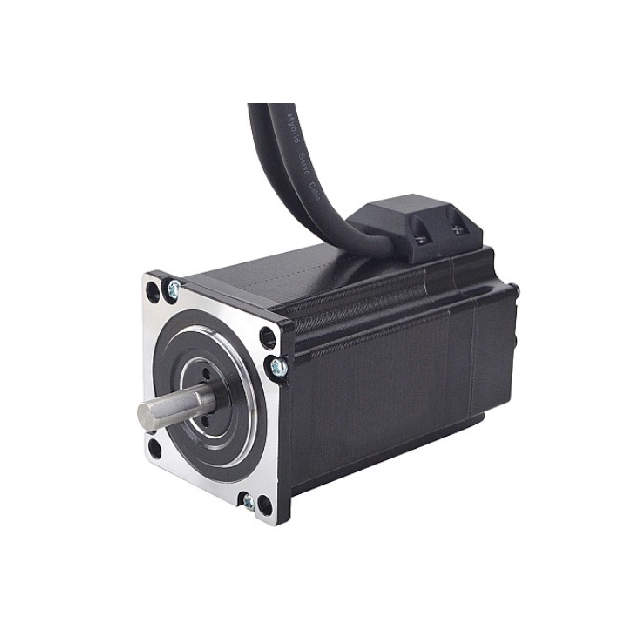
BF60HSN Series Closed-Loop Stepper Motor — High-Efficiency, Compact, and Smart Closed-Loop Motion Control Solution
Product Overview:The BESFOC NEMA 24 BF60HSN Series Stepper Motor is designed for precision motion-control applications requiring reliable positioning, stable torque output, and consistent rotational performance. Featuring a standardized NEMA 24 frame size, this stepper motor offers convenient mechanical integration into various industrial automation systems and equipment.
With its step-by-step positioning capability and compact structural design, the BF60HSN30 is suitable for applications involving controlled rotation, repetitive positioning, and automated motion sequences. It can be integrated with compatible stepper motor drivers and motion controllers to achieve accurate speed and position control.
Key Technical Highlights
- Standard NEMA 24 Frame Size: Features an approximately 60 mm mounting-face dimension, facilitating integration into compatible industrial equipment and mechanical assemblies.
- Precise Positioning Capability: Stepper motor technology enables controlled incremental rotation, making it suitable for repetitive positioning and accurate motion-control tasks.
- Stable Torque Output: Designed to provide controlled rotational force for applications requiring reliable movement and positioning under appropriately selected mechanical loads.
- Flexible Drive Compatibility: Can be integrated with compatible stepper motor drivers and motion controllers to support different positioning, speed-control, and automation requirements.
- Versatile Mechanical Integration: Suitable for various transmission configurations, including couplings, gearboxes, lead screws, and belt-driven mechanisms, depending on the application design.
Typical Applications
The NEMA 24 BF60HSN30 stepper motor can be considered for a variety of industrial automation and precision motion-control applications, including:
1. CNC Machines: Driving lead screws and positioning mechanisms for controlled movement along machine axes.
2. 3D Printers: Controlling linear movement and positioning mechanisms to support accurate printing operations.
3. Laser Engraving and Cutting Machines: Providing controlled movement for positioning laser heads and worktables.
4. Automated Packaging Equipment: Driving feeding, conveying, indexing, and positioning mechanisms in packaging systems.
5. Industrial Automation Systems: Supporting repetitive positioning, rotary indexing, and synchronized mechanical movements in automated production equipment.
3. How Does Encoder Feedback Improve Solar Panel Tilt Positioning Accuracy?
Encoder feedback is one of the most important features that distinguish closed-loop stepper motors from conventional open-loop designs.
In solar tracking applications, the controller calculates the desired panel angle according to the sun's position and sends the corresponding movement command to the motor.
However, actual motor movement can be affected by several mechanical and environmental factors, including:
Changes in solar panel weight distribution
Wind pressure on the panel surface
Mechanical friction in rotating joints
Gearbox transmission resistance
Structural vibration
Backlash in mechanical transmission components
Without position feedback, these disturbances may cause the motor to deviate from its commanded position.
A closed-loop stepper motor uses an encoder to monitor the actual rotor position throughout operation.
The basic feedback process involves four steps:
Step 1: Receive the Target Position
The solar tracking controller calculates the required tilt angle and sends a positioning command to the motor driver.
For example, the target position may be 25 degrees.
Step 2: Execute the Movement
The motor driver energizes the stator windings, generating electromagnetic torque that rotates the motor shaft toward the commanded position.
Step 3: Detect Actual Position
The encoder continuously measures the rotor's rotational position and transmits feedback signals to the driver.
Step 4: Correct Positioning Errors
The driver compares the actual position with the target position. If a deviation is detected, the control system adjusts motor operation to reduce the positioning error.
This feedback mechanism helps maintain accurate motor positioning even when operating conditions change.
For example, if wind resistance increases during a tilt adjustment, the motor may require additional torque to complete the commanded movement. The closed-loop system can respond by adjusting the drive current within its operating limits.
As a result, encoder-based feedback improves positioning reliability and reduces the risk of undetected step loss.
It is important to distinguish motor-shaft positioning accuracy from actual panel-angle accuracy. Gearbox backlash, shaft flexibility, mounting tolerances, and structural deformation can still affect the final panel position. For applications requiring high angular accuracy, additional output-side feedback may be necessary.
4. How Do Closed-Loop Stepper Motors Maintain Sufficient Torque Under Changing Loads?
Solar panel tilt adjustment systems operate under continuously changing mechanical conditions.
Unlike small positioning mechanisms operating inside controlled industrial environments, outdoor solar tracking equipment must withstand wind pressure, temperature variations, mechanical friction, and changing structural loads.
These conditions create additional torque requirements for the drive system.
The required motor torque generally depends on several factors:
Solar panel dimensions and weight
Distance between the panel's center of gravity and rotation axis
Wind-induced mechanical resistance
Transmission efficiency
Acceleration and deceleration requirements
Friction within the mechanical assembly
When the external load increases, an open-loop stepper motor may fail to generate sufficient torque to maintain the commanded movement.
A closed-loop stepper motor can use encoder feedback to identify positioning deviations and adjust its current output accordingly.
This allows the motor to respond dynamically to changing load conditions.
For example, when a large solar panel begins rotating against increased wind resistance, the driver can increase motor current within the motor's rated limits to generate additional torque.
This feature provides several practical advantages:
Improved Load Adaptability: The motor can respond to changes in mechanical resistance instead of relying entirely on predetermined drive parameters.
Reduced Positioning Errors: Feedback helps identify deviations caused by insufficient torque or unexpected disturbances.
More Efficient Current Control: The driver can adjust current according to actual operating requirements rather than continuously supplying excessive current.
More Reliable Motion: The system can maintain more consistent positioning performance under varying load conditions.
Nevertheless, closed-loop feedback does not eliminate the motor's physical torque limitations. Motor selection must still account for maximum static holding torque, operating torque, acceleration requirements, gearbox efficiency, and potential wind loading.
5. Why Are Closed-Loop Stepper Motors Beneficial for Worm Gear Solar Tracking Mechanisms?
Worm gear mechanisms are widely used in solar panel tilt adjustment systems because they provide high torque output, compact transmission structures, and low-speed rotational control.
When paired with closed-loop stepper motors, worm gearboxes offer a practical solution for controlling solar panel positioning.
Key advantages include:
High Torque Output: The worm gearbox increases output torque, allowing the motor to drive large solar panels against mechanical resistance and changing loads.
Precise Positioning: Encoder feedback monitors motor shaft movement, helping the driver detect and correct positioning deviations during panel angle adjustment.
Stable Low-Speed Operation: The high reduction ratio of worm gearboxes allows slow, controlled panel rotation, supporting gradual solar tracking movements.
Compact Mechanical Design: The combination of a closed-loop stepper motor and worm gearbox provides a space-efficient drive solution for solar tracking structures.
Improved Load Adaptability: Closed-loop feedback enables the motor driver to adjust current when mechanical resistance changes, helping maintain reliable movement.
For example, when a solar tracking controller commands a 10-degree tilt adjustment, the closed-loop stepper motor drives the worm gearbox according to the required transmission ratio. The encoder monitors motor rotation, allowing the driver to correct deviations from the commanded motor position.
By combining encoder-based feedback with worm gear torque multiplication, closed-loop stepper motors help solar tracking systems achieve controlled, repeatable, and reliable panel tilt adjustment.
However, motor-side encoder feedback cannot directly eliminate gearbox backlash. For applications requiring higher output-angle accuracy, an additional encoder installed on the panel rotation shaft may be necessary.
6. How Do Closed-Loop Stepper Motors Reduce Energy Consumption in Solar Tracking Applications?
Energy efficiency is a major consideration in solar tracking equipment, particularly in off-grid solar installations and remote photovoltaic systems.
Since solar tracking mechanisms operate outdoors and may have limited access to external power supplies, reducing unnecessary motor energy consumption is important.
Closed-loop stepper motors can contribute to improved energy efficiency through intelligent current regulation.
In traditional open-loop stepper systems, the driver may maintain a relatively high current level to prevent potential step loss, even when the actual mechanical load is low.
Closed-loop systems can monitor motor operation and adjust current according to the required torque.
This approach provides several potential energy-saving benefits.
1. Current Adjustment According to Actual Load
When the solar panel moves under relatively low resistance, the driver may reduce the supplied current while maintaining the required motion.
2. Reduced Unnecessary Motor Heating
Lower current consumption under suitable operating conditions can reduce winding heat generation.
3. Improved Motion Control
Feedback helps prevent repeated positioning attempts caused by undetected step loss, reducing unnecessary motor operation.
4. Optimized Holding Operation
Depending on the driver configuration, the motor can reduce holding current when full holding torque is unnecessary.
However, solar tracking systems must consider the holding torque required to maintain panel position against wind and gravitational loads.
Reducing holding current too aggressively may compromise mechanical stability.
Therefore, an effective energy management strategy should coordinate motor current control with the mechanical holding characteristics of the gearbox or braking mechanism.
7. How Do Closed-Loop Stepper Motors Improve Long-Term Reliability in Outdoor Solar Tracking Equipment?
Outdoor solar tracking equipment must operate reliably over extended periods with limited maintenance.
Unlike indoor automation equipment, solar panel adjustment systems are exposed to environmental conditions that can gradually affect mechanical performance.
Common challenges include:
Temperature fluctuations
Dust and moisture exposure
Wind-induced vibration
Mechanical wear
Lubrication degradation
Cable aging
Transmission backlash
These factors can increase mechanical resistance and affect positioning performance over time.
Closed-loop stepper motors help improve system reliability by providing continuous position monitoring.
If the motor encounters unexpected resistance or experiences a positioning deviation, the controller can detect the error and respond accordingly.
Depending on the driver and control configuration, the system may also provide alarms for excessive following error, overload conditions, or abnormal operation.
This information allows the main controller to identify potential mechanical problems before they develop into more serious failures.
For example, if a solar panel rotation mechanism gradually develops increased friction because of bearing wear, the motor may require more current to complete the same positioning movement.
The closed-loop driver can respond to the increased load, while monitoring current and positioning errors can help identify abnormal operating conditions.
For outdoor installations, the motor and driver should also be selected with appropriate environmental protection.
Important considerations include:
Suitable enclosure protection ratings
Operating temperature range
Moisture resistance
Dust protection
Corrosion-resistant mounting components
Appropriate cable connectors
Effective thermal management
Combining closed-loop motor control with suitable mechanical protection helps improve the long-term operational reliability of solar tracking systems.
8. What Are the Key Parameters When Selecting Closed-Loop Stepper Motors for Solar Panel Tilt Adjustment?
Selecting the correct closed-loop stepper motor requires evaluating the mechanical structure, positioning requirements, environmental conditions, and control architecture of the solar tracking system.
An undersized motor may struggle to overcome external loads, while an oversized motor may increase installation costs and energy consumption.
The following parameters should be considered.
8.1 Rated Torque and Peak Torque
Torque is one of the most important motor selection parameters.
The motor must generate sufficient torque to overcome the combined resistance of the panel structure, transmission mechanism, friction, and external environmental loads.
When calculating the required torque, engineers should consider the panel's center of gravity, rotational inertia, wind-induced forces, and gearbox efficiency.
A suitable safety margin should also be included to accommodate unexpected load variations.
8.2 Motor Size and Installation Space
The motor's frame size must match the available installation space.
Common stepper motor frame sizes include:
NEMA 17
NEMA 23
NEMA 34
NEMA 17 motors may be suitable for compact, lightweight positioning mechanisms.
NEMA 23 closed-loop stepper motors are often considered for medium-sized solar tracking mechanisms requiring a balance between torque output, installation dimensions, and cost.
NEMA 34 motors may be appropriate for larger positioning assemblies with higher torque requirements.
The final selection should be based on actual load calculations rather than frame size alone.
8.3 Encoder Resolution
Encoder resolution determines how finely the motor's rotational position can be measured.
A higher encoder resolution provides more detailed position feedback, which can improve the controller's ability to detect small positioning deviations.
However, encoder resolution is not equivalent to guaranteed mechanical positioning accuracy.
The final accuracy also depends on motor characteristics, transmission backlash, structural stiffness, control algorithms, and installation tolerances.
8.4 Gearbox Reduction Ratio
The gearbox reduction ratio determines the relationship between motor speed and output speed.
A higher reduction ratio generally increases output torque while reducing output rotational speed.
For solar panel tilt adjustment systems, the appropriate ratio depends on:
Required panel adjustment speed
Maximum output torque
Desired angular positioning resolution
Transmission efficiency
Backdriving characteristics
Worm gearboxes are particularly useful when a compact, high-reduction transmission is required.
8.5 Protection and Operating Temperature
Since solar tracking systems are commonly installed outdoors, environmental adaptability is essential.
The motor should be selected according to the installation environment, with particular attention to dust, moisture, temperature, and vibration.
An appropriate enclosure and protection strategy can help prevent premature component failure.
9. Closed-Loop Stepper Motors vs. Open-Loop Stepper Motors for Solar Panel Tilt Adjustment
Both open-loop and closed-loop stepper motors can be used in solar tracking applications. However, their control characteristics differ significantly.
For simple solar panel adjustment mechanisms with relatively stable loads and limited precision requirements, open-loop stepper motors may provide an economical solution.
However, for larger panels, variable mechanical loads, or applications requiring more dependable positioning, closed-loop stepper motors offer important advantages.
Their encoder-based feedback provides greater control over actual motor movement and helps reduce the risk of positioning errors caused by unexpected operating conditions.
10. How Do Closed-Loop Stepper Motors Work with Solar Tracking Controllers?
A complete solar tracking system requires coordination between the motor drive, position feedback, and solar tracking controller.
The controller determines the desired panel orientation using astronomical calculations, light sensors, or a combination of both.
The closed-loop stepper motor then executes the corresponding positioning commands.
A typical control process includes the following stages.
Stage 1: Solar Position Calculation
The main controller calculates the sun's elevation and azimuth angles based on geographical coordinates, date, and time.
Stage 2: Target Tilt Angle Generation
The controller converts the calculated solar position into a target panel angle according to the tracking system's mechanical configuration.
Stage 3: Motor Position Command
The target movement is transmitted to the closed-loop stepper driver through a suitable control interface, such as pulse-and-direction signals or an available communication protocol.
Stage 4: Motor Movement and Encoder Feedback
The motor rotates toward the commanded position while the encoder continuously monitors rotor movement.
Stage 5: Position Error Correction
The driver compares actual and commanded positions and adjusts motor operation when necessary.
Stage 6: Position Maintenance
Once the target position is reached, the system maintains the required mechanical position through suitable motor holding control, gearbox characteristics, or a dedicated braking mechanism.
This coordinated operation allows solar tracking equipment to achieve controlled and repeatable panel positioning.
For dual-axis solar tracking systems, two independent closed-loop motor assemblies can control the horizontal and vertical positioning axes.
The main controller coordinates both axes to achieve the required panel orientation.
11. Common Challenges in Applying Closed-Loop Stepper Motors to Solar Tracking Systems
Although closed-loop stepper motors provide significant positioning advantages, successful integration requires careful consideration of the complete mechanical and electrical system.
11. Common Challenges in Applying Closed-Loop Stepper Motors to Solar Tracking Systems
Although closed-loop stepper motors provide accurate positioning and reliable motion control, their application in solar tracking systems still involves several challenges.
Wind-Induced Loads: Strong winds increase resistance on solar panels, requiring sufficient motor torque and a reliable wind-stow mechanism to prevent structural damage.
Gearbox Backlash: Mechanical clearance in worm gearboxes and other transmission components can affect the final panel positioning accuracy. Proper gearbox selection and output-side feedback can help reduce positioning errors.
Power Supply Stability: Insufficient voltage or current may affect motor performance, particularly during acceleration and high-load operation. A stable power supply should match the driver's electrical requirements.
Thermal Management: Continuous operation under high loads can increase motor and driver temperatures. Appropriate current settings and heat dissipation are essential for reliable operation.
Mechanical Holding: Motor holding torque alone may not be sufficient to maintain panel stability under strong wind conditions. Self-locking gearboxes, mechanical brakes, or additional locking mechanisms may be necessary.
By addressing these challenges through proper motor selection, transmission design, and control system optimization, engineers can improve the positioning accuracy, operational stability, and service life of solar tracking systems.
12. Future Trends in Closed-Loop Motor Technology for Solar Tracking Systems
As solar energy systems continue to develop, solar tracking mechanisms are becoming increasingly sophisticated.
Future solar tracking equipment is expected to place greater emphasis on intelligent control, energy efficiency, system integration, and predictive maintenance.
Closed-loop stepper motors can support these developments through improved position feedback and more flexible motion control.
Several trends are particularly relevant.
Intelligent Motion Control
Advanced control algorithms can optimize motor acceleration, deceleration, and positioning according to actual operating conditions.
Integrated Motor and Driver Solutions
Integrated closed-loop stepper motors combine the motor, encoder, and driver into a compact assembly, simplifying wiring and reducing installation complexity.
Predictive Maintenance
Positioning errors, current variations, and abnormal operating conditions can provide useful information for identifying developing mechanical problems.
Remote Monitoring
Communication interfaces allow solar tracking controllers to collect motor operating information and monitor system status remotely.
Improved Energy Management
Optimized motor current control and intelligent tracking schedules can reduce unnecessary energy consumption.
These developments will make closed-loop motor technology increasingly valuable in solar tracking applications where positioning reliability, operational efficiency, and maintenance accessibility are important.
Conclusion
Closed-loop stepper motors enable precise positioning in solar panel tilt adjustment systems through encoder-based feedback, automatic positioning error correction, and adaptive current control. Unlike conventional open-loop stepper motors, they can monitor actual rotor movement and respond to positioning deviations caused by changing mechanical loads or unexpected resistance.
When combined with suitable gearboxes, mechanical transmission components, and intelligent solar tracking controllers, closed-loop stepper motors provide a reliable drive solution for single-axis and dual-axis solar tracking equipment.
Their advantages include improved positioning reliability, better load adaptability, reduced risk of undetected step loss, and more efficient motor operation.
For solar tracking applications requiring consistent angular positioning and dependable outdoor performance, selecting the appropriate closed-loop stepper motor is essential.
By evaluating motor torque, encoder resolution, frame size, gearbox reduction ratio, environmental protection, and mechanical holding requirements, engineers can develop solar panel tilt adjustment systems that deliver reliable positioning performance and support long-term solar energy generation.
FAQS:
1. What is a closed-loop stepper motor in a solar tracking system?
A closed-loop stepper motor is a positioning motor equipped with an encoder and feedback driver. It monitors actual rotor movement and corrects positioning deviations, helping solar tracking systems achieve accurate and reliable panel angle adjustments.
2. How do closed-loop stepper motors improve solar panel tilt adjustment accuracy?
Closed-loop stepper motors use encoder feedback to compare actual motor position with the commanded position. When deviations occur, the driver adjusts motor operation to correct positioning errors, improving the repeatability and reliability of solar panel tilt adjustments.
3. Why are closed-loop stepper motors better than open-loop stepper motors for solar tracking?
Unlike open-loop stepper motors, closed-loop models can detect positioning errors and respond to missed steps. They also offer improved load adaptability and current regulation, making them suitable for solar tracking applications with changing mechanical resistance.
4. Can closed-loop stepper motors handle wind loads in solar panel tracking systems?
Yes. Closed-loop stepper motors can adjust their output current within rated operating limits to respond to increased mechanical resistance caused by wind loads. However, motor torque, gearbox capacity, structural strength, and additional wind protection must be properly designed.
5. Why are worm gearboxes commonly paired with closed-loop stepper motors in solar tracking systems?
Worm gearboxes provide high reduction ratios, increased output torque, and compact transmission structures. When combined with closed-loop stepper motors, they support controlled, low-speed solar panel rotation and reliable tilt adjustment.
6. How does encoder feedback help prevent missed steps in solar tracking applications?
The encoder continuously monitors rotor position and sends feedback to the motor driver. If actual movement deviates from the commanded position, the driver can adjust current and motor operation to reduce the positioning error, helping prevent undetected step loss.
7. What size closed-loop stepper motor is suitable for solar panel tilt adjustment?
The appropriate motor size depends on panel weight, dimensions, rotational inertia, wind resistance, gearbox ratio, and required adjustment speed. NEMA 23 and NEMA 34 closed-loop stepper motors are potential options for medium- and higher-load applications, respectively, but torque calculations should determine the final selection.
8. Do closed-loop stepper motors reduce energy consumption in solar tracking systems?
Yes. Closed-loop stepper drivers can regulate motor current according to operating conditions, reducing unnecessary current consumption and heat generation. Actual energy savings depend on load, driver settings, holding requirements, and tracking frequency.
9. Can closed-loop stepper motors be used in dual-axis solar tracking systems?
Yes. Two closed-loop stepper motor assemblies can independently control the horizontal and vertical axes. Coordinated control allows the solar tracking system to adjust both azimuth and elevation angles for improved solar panel alignment.
10. What factors should be considered when selecting a closed-loop stepper motor for solar tracking?
Important factors include rated torque, peak torque, encoder resolution, motor frame size, gearbox reduction ratio, operating speed, power supply, environmental protection, and mechanical holding requirements. Proper evaluation ensures reliable positioning and long-term operation.

 English
 العربية
 Français
 Русский
 Español
 Português
 Deutsch
 italiano
 日本語
 한국어
 Nederlands
 Tiếng Việt
 ไทย
 Polski
 Türkçe
 ພາສາລາວ
 ភាសាខ្មែរ
 Bahasa Melayu
 ဗမာစာ
 Filipino
 Bahasa Indonesia
 magyar
 Română
 Čeština
 Монгол
 қазақ
 Српски
 हिन्दी
 فارسی
 Slovenčina
 Slovenščina
 Norsk
 Svenska
 українська
 Ελληνικά
 Suomi
 Հայերեն
 עברית
 Latine
 Dansk
 Shqip
 বাংলা
 Hrvatski
 Afrikaans
 Gaeilge
 Eesti keel
 Oʻzbekcha
 latviešu
 Azərbaycan dili
 Български
 Català