Autonomous robotic lawn mowers rely on precise motion control to navigate complex lawn environments, maintain consistent cutting paths, and avoid obstacles without continuous human intervention. Unlike conventional lawn mowers, which depend on manual steering, autonomous models must coordinate multiple motion-control components to achieve accurate positioning, reliable directional changes, and stable operation across different terrain conditions. Among these components, the steering drive system plays a particularly important role in determining navigation accuracy and operational efficiency.
NEMA 23 closed-loop stepper motors offer a practical motion-control solution for autonomous robotic lawn mower steering mechanisms that require accurate positioning, responsive directional adjustment, and reliable torque output. By combining the positioning characteristics of stepper motors with encoder-based feedback, these motors can detect position errors, correct deviations, and maintain more consistent steering movement under changing mechanical loads.
Compared with traditional open-loop stepper motors, NEMA 23 closed-loop stepper motors provide improved motion verification and better protection against missed-step positioning errors. These capabilities are particularly valuable in robotic lawn mowers that must navigate irregular lawn boundaries, execute precise turning maneuvers, and maintain predictable movement across varying grass conditions.
We will examine how NEMA 23 closed-loop stepper motors improve steering accuracy in autonomous robotic lawn mowers, focusing on encoder feedback, torque management, directional positioning, terrain adaptability, and system integration.
1. Why Is Steering Accuracy Important in Autonomous Robotic Lawn Mowers?
Steering accuracy directly affects the navigation performance, cutting consistency, and operational reliability of autonomous robotic lawn mowers.
During automatic mowing, the machine must follow predefined routes, maintain appropriate cutting coverage, and adjust its direction when encountering boundaries or obstacles. Even small steering deviations can accumulate over repeated movements, resulting in missed cutting areas, overlapping mowing paths, or unnecessary movement.
Several operating conditions make accurate steering particularly challenging:
Irregular lawn boundaries: Robotic lawn mowers frequently operate around curved garden edges, flower beds, trees, and other obstacles.
Uneven ground conditions: Slopes, bumps, and changes in grass resistance can affect wheel traction and steering response.
Variable mechanical loads: Grass resistance, wheel friction, and ground contact conditions can change during operation.
Continuous autonomous operation: The steering system must maintain predictable movement over extended operating periods without frequent manual intervention.
A reliable steering actuator must therefore provide repeatable angular positioning, sufficient torque, and effective feedback to minimize positioning deviations.
NEMA 23 closed-loop stepper motors address these requirements by combining controlled step positioning with encoder-based motion monitoring.
2. How Do NEMA 23 Closed-Loop Stepper Motors Work in Steering Systems?
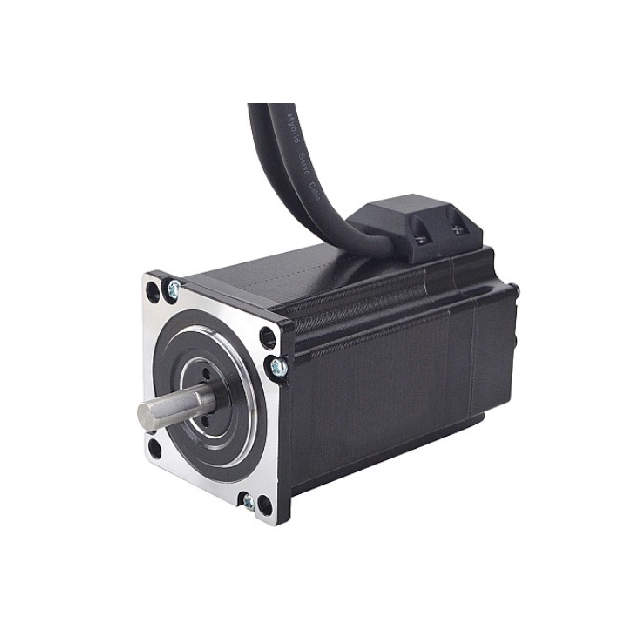
A NEMA 23 closed-loop stepper motor integrates a stepper motor with an encoder and a compatible closed-loop driver. The NEMA 23 designation refers to the motor's approximately 2.3-inch (57 mm) mounting-face dimension, making it suitable for compact industrial and mobile machinery where moderate torque and manageable installation dimensions are required.
In an autonomous robotic lawn mower, the motor can drive a steering linkage, steering gear, or other mechanical transmission responsible for changing wheel direction.
The operating process generally involves four stages:
Step 1: Position Command Generation
The main navigation controller calculates the required steering position based on the mower's current position, target trajectory, and navigation sensor information. It then sends a corresponding position or motion command to the motor driver.
Step 2: Controlled Motor Rotation
The closed-loop driver supplies appropriately sequenced current to the motor windings, generating controlled rotational movement. The motor rotates according to the commanded step position.
Step 3: Encoder Position Detection
An encoder continuously monitors the motor shaft position and sends feedback information to the driver. This allows the system to compare the actual motor position with the commanded position.
Step 4: Position Error Correction
When the encoder detects a deviation between the commanded and actual positions, the closed-loop controller can adjust motor operation to reduce the positioning error, provided the system remains within its available torque and control limits.
This feedback-based operating principle helps prevent undetected positioning deviations that can occur in open-loop stepper motor systems.
BF57HSN Series Closed-Loop Stepper Motor — High-Efficiency, Compact, and Smart Closed-Loop Motion Control Solution
Product Overview:The BESFOC NEMA 23 BF57HSN Series Stepper Motor is designed for precision motion-control applications requiring reliable positioning, stable torque output, and consistent rotational performance. Featuring a standardized NEMA 23 frame size, this stepper motor offers convenient mechanical integration into various industrial automation systems and equipment.
With its step-by-step positioning capability and compact structural design, the BF57HSN30 is suitable for applications involving controlled rotation, repetitive positioning, and automated motion sequences. It can be integrated with compatible stepper motor drivers and motion controllers to achieve accurate speed and position control.
Key Technical Highlights
- Standard NEMA 23 Frame Size: Features an approximately 57 mm mounting-face dimension, facilitating integration into compatible industrial equipment and mechanical assemblies.
- Precise Positioning Capability: Stepper motor technology enables controlled incremental rotation, making it suitable for repetitive positioning and accurate motion-control tasks.
- Stable Torque Output: Designed to provide controlled rotational force for applications requiring reliable movement and positioning under appropriately selected mechanical loads.
- Flexible Drive Compatibility: Can be integrated with compatible stepper motor drivers and motion controllers to support different positioning, speed-control, and automation requirements.
- Versatile Mechanical Integration: Suitable for various transmission configurations, including couplings, gearboxes, lead screws, and belt-driven mechanisms, depending on the application design.
Typical Applications
The NEMA 23 BF57HSN30 stepper motor can be considered for a variety of industrial automation and precision motion-control applications, including:
1. CNC Machines: Driving lead screws and positioning mechanisms for controlled movement along machine axes.
2. 3D Printers: Controlling linear movement and positioning mechanisms to support accurate printing operations.
3. Laser Engraving and Cutting Machines: Providing controlled movement for positioning laser heads and worktables.
4. Automated Packaging Equipment: Driving feeding, conveying, indexing, and positioning mechanisms in packaging systems.
5. Industrial Automation Systems: Supporting repetitive positioning, rotary indexing, and synchronized mechanical movements in automated production equipment.
3. How Does Encoder Feedback Improve Steering Positioning Accuracy?
Encoder feedback is one of the most important advantages of NEMA 23 closed-loop stepper motors in autonomous robotic lawn mower steering applications.
Traditional open-loop stepper motors execute commanded step sequences without directly verifying whether the motor shaft has reached the intended position. If an unexpected mechanical load exceeds the available torque, the motor may lose synchronization with the commanded movement.
In a steering mechanism, this can create differences between the expected and actual steering positions.
A closed-loop stepper motor addresses this problem through continuous position monitoring.
Real-Time Position Verification
The encoder provides actual motor position information to the closed-loop driver. By comparing feedback with the commanded position, the controller can identify motion deviations and initiate corrective action.
This is particularly useful when the mower encounters:
Increased steering resistance on thick grass.
Mechanical friction within steering linkages.
Sudden changes in wheel loading.
Resistance during low-speed directional adjustments.
Repeated steering movements during complex navigation routes.
Reduced Missed-Step Positioning Errors
When a conventional stepper motor loses steps, the controller may continue operating under the assumption that the commanded position has been achieved.
Closed-loop feedback helps identify this discrepancy rather than allowing the positioning error to remain undetected.
For autonomous lawn mowers, this improves the reliability of repeated steering commands and reduces the possibility of accumulated motor-position errors.
More Consistent Steering Response
With encoder feedback, the steering drive can better maintain correspondence between commanded and actual motor positions.
This improves the repeatability of steering movements, particularly when the mower frequently changes direction or follows curved navigation paths.
However, actual wheel-angle accuracy also depends on transmission backlash, mechanical compliance, steering calibration, and the relationship between motor rotation and wheel movement.
4. How Does NEMA 23 Motor Torque Support Reliable Steering on Uneven Lawns?
Torque availability is another important consideration when selecting a steering motor for an autonomous robotic lawn mower.
Unlike indoor positioning equipment operating under relatively stable mechanical conditions, robotic lawn mowers must navigate outdoor environments where ground resistance and wheel loading can change considerably.
For example, when a mower moves across thick grass or transitions between flat ground and a slope, the steering mechanism may experience additional resistance. If the actuator cannot generate sufficient torque, steering movement may become inconsistent or fail to reach the commanded position.
NEMA 23 closed-loop stepper motors can provide useful torque capacity for steering mechanisms designed around their available motor characteristics.
Maintaining Steering Movement Under Variable Loads
Closed-loop control allows the driver to monitor motor position while responding to changes in mechanical load.
When additional resistance causes the motor to deviate from its commanded position, the driver can increase or adjust motor current within its configured operating limits to recover the target position.
This helps maintain more reliable steering operation under changing load conditions.
Supporting Repeated Steering Adjustments
Autonomous lawn mowers frequently execute small steering corrections to maintain their planned trajectories.
These movements require the motor to provide sufficient torque at the relevant operating speeds, rather than relying exclusively on its maximum holding torque specification.
When selecting a NEMA 23 motor, we recommend evaluating:
Rated phase current.
Holding torque.
Available torque at operating speed.
Supply voltage and driver compatibility.
Acceleration and deceleration requirements.
Thermal performance during repeated operation.
The motor must provide sufficient dynamic torque throughout the steering movement, not simply a high static holding-torque value.
5. How Do Closed-Loop Stepper Motors Improve Directional Changes and Turning Control?
Directional changes and turning control are essential to the navigation accuracy of autonomous robotic lawn mowers. During automatic mowing, the machine must frequently adjust its steering direction when following curved lawn boundaries, avoiding obstacles, changing mowing lanes, or performing U-turns at the end of a mowing path. These operations require the steering motor to deliver precise positioning, stable torque output, and repeatable rotational movement.
NEMA 23 closed-loop stepper motors improve steering performance by combining accurate step positioning with encoder-based feedback. When the navigation controller sends a steering command, the motor executes the required rotation while the encoder continuously monitors its actual shaft position. The closed-loop driver compares the commanded position with the encoder feedback and responds to detected deviations. This helps reduce positioning errors caused by changing steering resistance, mechanical friction, or unexpected loads during directional adjustments.
Several features contribute to more accurate turning and directional control:
Precise Steering Angle Adjustment: Closed-loop stepper motors can execute programmed rotational movements corresponding to specific steering positions. This allows robotic lawn mowers to make small directional corrections when following curved boundaries and larger steering adjustments when performing tight turns.
Smooth Acceleration and Deceleration: During turning operations, sudden changes in motor speed can cause mechanical shock and unstable steering responses. With programmable acceleration and deceleration profiles, the motor driver can control rotational movement more smoothly, reducing vibration and mechanical stress on steering components.
Consistent Left and Right Turning: Autonomous lawn mowers frequently perform repeated turning movements when switching between parallel mowing paths. Encoder feedback helps verify motor positioning during these movements, improving the repeatability of steering commands and reducing the risk of accumulated motor-position errors.
Reliable Performance Under Variable Loads: Steering resistance can change when the mower travels across thick grass, uneven ground, or sloped surfaces. A closed-loop control system can detect deviations between the commanded and actual motor positions and make corrective adjustments within the available torque and current limits.
Improved Directional Transition: When changing from forward movement to a turning maneuver and then returning to a straight mowing path, the steering mechanism must respond consistently to successive position commands. Closed-loop stepper motors help maintain more predictable actuator positioning throughout these transitions.
In addition, the motor's holding torque can help maintain the commanded steering position when the actuator is stationary, provided the motor and driver are correctly sized for the applied load. This is particularly useful when the mower needs to maintain a specific steering angle during a controlled turning sequence.
By integrating NEMA 23 closed-loop stepper motors into the steering mechanism, autonomous robotic lawn mowers can achieve more repeatable steering angles, smoother directional transitions, and more reliable turning movements. When combined with properly designed steering linkages, low-backlash transmission components, and vehicle-level navigation feedback, these motors help improve overall path-following consistency and mowing efficiency.
6. How Do NEMA 23 Closed-Loop Stepper Motors Support Navigation Accuracy?
Accurate steering is only one part of autonomous navigation. A robotic lawn mower must also determine its location, calculate its trajectory, and continuously evaluate its movement relative to the planned route.
NEMA 23 closed-loop stepper motors can support the execution of navigation commands generated by the mower's central control system.
A typical autonomous navigation architecture may include:
GNSS or RTK-GNSS: Provides outdoor positioning information, with RTK systems offering enhanced positioning accuracy under suitable operating conditions.
IMU sensors: Measure angular velocity and acceleration to help estimate vehicle orientation and movement.
Wheel encoders: Provide wheel rotation information for odometry and speed estimation.
Obstacle detection sensors: Detect obstacles and support collision-avoidance decisions.
Main navigation controller: Processes sensor information and calculates steering commands.
Closed-loop steering motor: Executes commanded steering movements and monitors its own shaft position.
These components perform different functions.
The navigation controller determines where the mower should travel, while the steering actuator executes the corresponding mechanical movement.
By providing encoder-based motor-position feedback, a NEMA 23 closed-loop stepper motor helps ensure that the steering actuator responds more consistently to navigation commands.
For applications requiring higher overall steering accuracy, we recommend combining motor encoder feedback with independent steering-angle sensing and vehicle-level navigation feedback.
This arrangement allows the control system to identify not only motor-position errors but also deviations caused by mechanical backlash, wheel slip, or changes in vehicle dynamics.
7. Why Are Closed-Loop Stepper Motors More Suitable Than Open-Loop Stepper Motors for Autonomous Lawn Mowers?
Both open-loop and closed-loop stepper motors can be used in automated motion-control systems. However, their differences become important when the steering mechanism operates under variable outdoor conditions.
Performance Factor
Open-Loop Stepper Motor
NEMA 23 Closed-Loop Stepper Motor
Position feedback
No inherent encoder feedback
Encoder-based position feedback
Missed-step detection
Generally unavailable
Position deviations can be detected
Position correction
No automatic feedback correction
Driver can correct detected errors
Load response
Limited by open-loop torque margin
Feedback-based response to position deviations
Motion verification
Assumes commanded steps are executed
Monitors actual motor shaft position
System complexity
Relatively simple
Requires encoder and compatible driver
Steering reliability
Depends heavily on sufficient torque margin
Improved motion monitoring under variable loads
For autonomous robotic lawn mowers, the main advantage is not simply that closed-loop stepper motors can produce rotational movement. It is that they provide a mechanism for verifying and correcting motor positioning.
This is particularly valuable in equipment that performs repeated directional changes and operates under changing mechanical resistance.
Nevertheless, a properly sized open-loop stepper motor may remain suitable for simpler steering mechanisms with predictable loads and sufficient torque margins.
The selection should depend on the actual mechanical design, required positioning accuracy, operating conditions, and system cost.
8. What Should We Consider When Selecting a NEMA 23 Closed-Loop Stepper Motor for Robotic Lawn Mower Steering?
Selecting the right NEMA 23 closed-loop stepper motor for an autonomous robotic lawn mower requires evaluating more than the motor's frame size and rated torque. The steering system must operate reliably under changing outdoor conditions, including uneven terrain, variable steering resistance, frequent directional changes, and continuous operating cycles. Therefore, we need to consider the motor's electrical specifications, mechanical characteristics, feedback performance, and environmental adaptability to ensure compatibility with the complete steering mechanism.
The following factors are particularly important when selecting a suitable motor.
8.1 Torque Requirements and Load Capacity
Torque is one of the most important parameters affecting steering performance. During operation, the motor must overcome resistance from steering linkages, gear transmissions, wheel friction, and changing ground conditions.
For robotic lawn mower applications, we should evaluate both holding torque and dynamic torque. Holding torque determines the motor's ability to maintain a stationary position, while dynamic torque determines its ability to execute steering movements at the required operating speed.
When selecting a motor, we should consider:
Maximum steering resistance under normal operating conditions.
Additional torque requirements when turning on slopes or uneven terrain.
Mechanical friction and transmission efficiency.
Acceleration and deceleration requirements during steering movements.
An appropriate torque safety margin to accommodate unexpected load variations.
A motor with insufficient torque may experience positioning deviations or fail to complete the commanded steering movement.
8.2 Encoder Resolution and Positioning Accuracy
Encoder performance directly affects the motor's ability to monitor its actual rotational position. A suitable encoder provides sufficient feedback resolution for the steering mechanism's positioning requirements.
We should consider the following parameters:
Encoder resolution: Determines the available position feedback granularity.
Position feedback accuracy: Affects how accurately the system can identify motor-position deviations.
Feedback stability: Ensures reliable position information during frequent steering adjustments.
Driver compatibility: Requires the encoder interface and feedback specifications to match the closed-loop driver.
Higher encoder resolution does not automatically guarantee higher wheel-angle accuracy. Mechanical backlash, transmission ratios, linkage tolerances, and steering calibration must also be considered.
8.3 Operating Speed and Motion Response
Autonomous robotic lawn mowers frequently perform small steering corrections, gradual directional changes, and tighter turning maneuvers. The motor must therefore provide sufficient torque across the required operating-speed range.
We should evaluate:
Required steering rotation speed.
Acceleration and deceleration capabilities.
Response time to position commands.
Torque availability at different operating speeds.
Performance during frequent start-stop cycles.
A properly matched motor and driver can provide controlled acceleration and deceleration, helping reduce vibration and mechanical impact during directional changes.
8.4 Motor Driver and Control Compatibility
The closed-loop stepper motor must work seamlessly with the mower's main controller and steering-control architecture.
Before selecting a motor, we should verify:
Rated phase current and driver output-current compatibility.
Operating voltage and power-supply requirements.
Encoder signal type and electrical interface.
Supported control modes, such as pulse-and-direction.
Communication compatibility with the main control system, where applicable.
Protection functions, including overcurrent, overvoltage, and position-error monitoring.
Proper motor-driver matching helps ensure stable operation and allows the steering controller to execute position commands reliably.
8.5 Environmental Protection and Thermal Performance
Unlike motors used in indoor automation equipment, robotic lawn mower steering motors operate in outdoor environments exposed to dust, grass debris, moisture, vibration, and temperature fluctuations.
Therefore, environmental protection is an important selection consideration.
We should pay attention to:
Ingress protection: Select an appropriate IP rating for the actual exposure to dust and moisture.
Operating temperature: Ensure the motor and driver can operate within the expected outdoor temperature range.
Heat dissipation: Evaluate temperature rise during continuous or frequent steering operations.
Vibration resistance: Ensure the motor assembly and encoder connections remain stable during movement across uneven lawns.
Cable protection: Use suitable connectors, sealing structures, and cable routing to reduce the risk of moisture ingress and mechanical damage.
For demanding outdoor applications, additional protective enclosures or sealing solutions may be necessary.
8.6Mechanical Dimensions and Installation Compatibility
The NEMA 23 standard provides an approximately 57 mm mounting-face dimension, but this alone does not guarantee compatibility with the mower's steering assembly.
We should also evaluate:
Motor length and overall installation dimensions.
Shaft diameter and shaft extension.
Mounting-hole spacing and installation depth.
Compatibility with gearboxes, couplings, and steering linkages.
Available installation space and cable routing.
Mechanical rigidity and mounting stability.
A suitable mechanical configuration helps simplify installation, reduce alignment errors, and improve the overall reliability of the steering transmission.
8.7 Operating Reliability and Service Life
Autonomous robotic lawn mowers may perform repeated steering corrections throughout extended mowing cycles. The selected motor should therefore maintain stable performance under frequent acceleration, deceleration, and directional changes.
We should evaluate the motor's thermal characteristics, bearing quality, encoder reliability, and long-term operating performance.
In addition, the closed-loop driver should provide appropriate fault detection and alarm functions to help identify abnormal operating conditions, such as excessive following errors or motor overload.
Overall, selecting a NEMA 23 closed-loop stepper motor requires balancing torque capacity, encoder performance, operating speed, electrical compatibility, environmental protection, and installation requirements. By matching these parameters to the actual steering mechanism and operating conditions, we can build a more reliable motion-control system that supports accurate steering, consistent directional changes, and long-term autonomous lawn mower operation.
9. How Can Mechanical Integration Further Improve Steering Accuracy?
Even a high-performance closed-loop stepper motor cannot compensate completely for an inaccurate mechanical steering structure.
For this reason, we should consider the complete actuator assembly rather than evaluating the motor independently.
Several mechanical factors directly influence steering accuracy.
Low-backlash transmission: Excessive backlash between the motor and steering mechanism can create differences between motor shaft position and actual wheel angle. Low-backlash gearboxes and properly adjusted mechanical linkages help reduce this problem.
Rigid mounting structure: Motor mounting brackets should provide sufficient stiffness to prevent unwanted displacement under steering loads.
Accurate coupling: Proper shaft alignment and secure coupling connections help reduce vibration and mechanical positioning errors.
Steering calibration: The control system should establish the relationship between motor position and actual wheel angle. This is particularly important when gear reduction or nonlinear steering geometry is involved.
Independent angle measurement: For applications requiring higher precision, a steering-angle sensor can measure the actual steering output rather than relying exclusively on motor shaft feedback.
Combining these mechanical improvements with closed-loop motor control creates a more reliable steering system.
10. What Are the Main Benefits of NEMA 23 Closed-Loop Stepper Motors in Autonomous Robotic Lawn Mowers?
When correctly selected and integrated, NEMA 23 closed-loop stepper motors offer several practical benefits for autonomous lawn mower steering systems.
Improved positioning reliability: Encoder feedback helps detect deviations between commanded and actual motor positions.
Reduced missed-step risks: The closed-loop driver can respond to detected positioning errors within the available torque and operating limits.
Consistent directional control: Repeatable motor positioning supports more predictable steering adjustments.
Better load adaptability: Feedback-based control helps the motor respond to changing mechanical resistance.
Controlled turning movements: Programmable motion profiles support smoother acceleration and deceleration.
Improved system diagnostics: Position errors and certain motor operating conditions can be monitored by compatible drivers.
Compact integration: The NEMA 23 mounting format supports integration into appropriately designed steering assemblies.
These advantages make closed-loop stepper motors worth considering for autonomous robotic lawn mowers that require dependable steering actuation without the complexity of a larger industrial servo system.
Conclusion
NEMA 23 closed-loop stepper motors improve steering accuracy in autonomous robotic lawn mowers by combining controlled step positioning, encoder-based feedback, and position-error correction. Their ability to monitor actual motor movement helps reduce undetected missed-step errors and improves the repeatability of steering commands under changing mechanical loads.
From maintaining consistent wheel positioning to supporting repeated turning maneuvers and responding to variable steering resistance, these motors provide a practical solution for many automated steering mechanisms.
However, overall steering accuracy depends on more than motor performance. Proper torque sizing, mechanical transmission design, encoder configuration, steering calibration, and integration with navigation sensors are all essential.
For manufacturers developing autonomous robotic lawn mowers, selecting a properly configured NEMA 23 closed-loop stepper motor can help establish a more reliable and predictable steering-control architecture. By combining accurate motor positioning with suitable vehicle-level feedback, we can improve navigation consistency, reduce positioning errors, and support more efficient autonomous mowing operations.
FAQS:
FAQ 1: How Do NEMA 23 Closed-Loop Stepper Motors Improve Steering Accuracy in Autonomous Robotic Lawn Mowers?
NEMA 23 closed-loop stepper motors improve steering accuracy through encoder-based position feedback. The encoder monitors actual motor shaft movement and sends position information to the driver, allowing it to detect deviations between commanded and actual positions. The driver can then make corrective adjustments within the motor's operating limits, helping autonomous robotic lawn mowers achieve more consistent steering movements and reduce undetected positioning errors.
FAQ 2: Why Are Closed-Loop Stepper Motors Suitable for Autonomous Robotic Lawn Mower Steering Systems?
Closed-loop stepper motors are suitable for robotic lawn mower steering systems because they combine controlled step positioning with encoder feedback. This allows the steering actuator to monitor its actual movement, detect positioning deviations, and respond to changing mechanical loads. Their positioning capabilities, torque characteristics, and relatively straightforward integration make them practical for automated steering mechanisms.
FAQ 3: How Does Encoder Feedback Reduce Steering Positioning Errors?
Encoder feedback continuously monitors the motor shaft position and compares it with the commanded position. When the motor encounters unexpected resistance or loses synchronization with the commanded movement, the closed-loop driver can detect the resulting position error and initiate corrective action. This helps reduce undetected missed-step errors and improves the repeatability of steering movements.
FAQ 4: How Much Torque Does a NEMA 23 Closed-Loop Stepper Motor Need for Robotic Lawn Mower Steering?
The required torque depends on steering resistance, mechanical transmission efficiency, wheel loading, operating speed, and terrain conditions. Engineers should evaluate both holding torque and dynamic torque rather than relying exclusively on the motor's maximum holding torque specification. An appropriate torque safety margin is also necessary to accommodate unexpected resistance during turning and operation on uneven lawns.
FAQ 5: Can NEMA 23 Closed-Loop Stepper Motors Maintain Steering Accuracy on Uneven Lawns?
Yes. When properly sized and integrated, NEMA 23 closed-loop stepper motors can help maintain more consistent steering positioning on uneven lawns. Encoder feedback allows the driver to detect motor-position deviations caused by changing mechanical resistance and respond accordingly. However, overall steering performance also depends on wheel traction, steering geometry, transmission backlash, and available motor torque.
FAQ 6: How Do Closed-Loop Stepper Motors Improve Turning Control in Robotic Lawn Mowers?
Closed-loop stepper motors improve turning control by executing programmed rotational movements and monitoring actual shaft positions through encoder feedback. They support repeatable steering-angle adjustments, controlled acceleration and deceleration, and more consistent left and right turning movements. These capabilities help robotic lawn mowers perform U-turns, change mowing lanes, and follow programmed navigation paths more reliably.
FAQ 7: What Is the Difference Between Open-Loop and Closed-Loop Stepper Motors for Robotic Lawn Mowers?
The main difference is position feedback. Open-loop stepper motors execute commanded step sequences without inherently verifying actual shaft position, so missed steps may remain undetected. Closed-loop stepper motors use encoders to monitor actual movement and allow the driver to respond to detected position errors. This makes closed-loop systems particularly useful for robotic lawn mower steering applications involving variable loads and frequent directional changes.
FAQ 8: How Does a NEMA 23 Closed-Loop Stepper Motor Work with an Autonomous Navigation System?
A NEMA 23 closed-loop stepper motor receives steering commands from the mower's main controller, which processes information from navigation sensors such as GNSS, RTK-GNSS, IMUs, and wheel encoders. The motor driver executes the requested movement while the motor encoder monitors shaft position. Combining motor feedback with vehicle-level navigation information helps the mower maintain more consistent steering control and correct deviations from its planned trajectory.
FAQ 9: What Factors Should Be Considered When Selecting a NEMA 23 Closed-Loop Stepper Motor for Robotic Lawn Mowers?
Important selection factors include rated and dynamic torque, encoder resolution, operating speed, motor-driver compatibility, power-supply requirements, thermal performance, and environmental protection. Engineers should also evaluate motor dimensions, shaft configuration, mounting requirements, and compatibility with steering gearboxes or mechanical linkages. Proper motor sizing and mechanical integration are essential for reliable outdoor operation.
FAQ 10: Can NEMA 23 Closed-Loop Stepper Motors Improve the Reliability of Autonomous Lawn Mower Navigation?
Yes. By monitoring actual motor movement and detecting positioning deviations, NEMA 23 closed-loop stepper motors help improve the reliability of steering command execution. Their feedback capabilities support repeatable directional adjustments and more predictable turning movements. When integrated with appropriate navigation sensors, steering-angle feedback, and mechanical transmission components, they can contribute to more consistent autonomous mowing performance.

 English
 العربية
 Français
 Русский
 Español
 Português
 Deutsch
 italiano
 日本語
 한국어
 Nederlands
 Tiếng Việt
 ไทย
 Polski
 Türkçe
 ພາສາລາວ
 ភាសាខ្មែរ
 Bahasa Melayu
 ဗမာစာ
 Filipino
 Bahasa Indonesia
 magyar
 Română
 Čeština
 Монгол
 қазақ
 Српски
 हिन्दी
 فارسی
 Slovenčina
 Slovenščina
 Norsk
 Svenska
 українська
 Ελληνικά
 Suomi
 Հայերեն
 עברית
 Latine
 Dansk
 Shqip
 বাংলা
 Hrvatski
 Afrikaans
 Gaeilge
 Eesti keel
 Oʻzbekcha
 latviešu
 Azərbaycan dili
 Български
 Català