Autonomous outdoor inspection robots are increasingly used in industrial facilities, power substations, solar farms, agricultural fields, oil and gas installations, and other large-scale environments. These robots perform repetitive inspection tasks, collect visual data, detect equipment abnormalities, and monitor infrastructure without requiring continuous human operation. To accomplish these tasks effectively, they must maintain accurate camera positioning, stable image acquisition, and reliable movement under changing outdoor conditions.
One of the most important components supporting these capabilities is the pan-tilt positioning system. A pan-tilt mechanism allows an inspection camera, thermal imaging sensor, LiDAR unit, or other detection device to rotate horizontally and vertically. By adjusting these two axes independently, an autonomous robot can inspect different directions, track specific targets, and capture detailed images of objects at varying heights and distances.
However, outdoor inspection applications introduce several motion-control challenges. Wind, vibration, temperature fluctuations, mechanical resistance, and continuous positioning cycles can affect the accuracy of conventional open-loop positioning systems.
Closed-loop stepper motors provide an effective solution by combining the positioning characteristics of stepper motors with encoder-based feedback. This configuration allows the control system to monitor actual motor movement, identify positioning errors, and make corrections when necessary.
We will examine how closed-loop stepper motors enable precise pan-tilt control in autonomous outdoor inspection robots, focusing on their operating principles, positioning accuracy, synchronization, environmental adaptability, and practical engineering considerations.
1. Understanding Pan-Tilt Control Requirements in Autonomous Outdoor Inspection Robots
A pan-tilt system typically consists of two independently controlled rotational axes.
Pan axis: Controls horizontal rotation, allowing the inspection camera to scan left and right.
Tilt axis: Controls vertical rotation, allowing the camera to point upward or downward.
These axes work together to provide flexible viewing coverage. For example, an autonomous inspection robot traveling through an electrical substation may need to inspect circuit breakers, transformers, overhead transmission equipment, and ground-level connections.
Instead of physically repositioning the entire robot for every inspection target, the pan-tilt mechanism adjusts the camera orientation while the robot remains stationary or continues moving at a controlled speed.
This approach requires several important motion-control capabilities.
Accurate angular positioning: The system must rotate the camera to predefined angles so that inspection targets can be captured consistently.
Repeatable positioning: When the robot revisits the same inspection point, the camera should return to the same viewing direction.
Stable holding performance: The mechanism must maintain its position despite external disturbances, including wind loads and mechanical vibration.
Smooth rotational movement: Sudden acceleration, deceleration, or mechanical vibration can reduce image quality and interfere with visual recognition algorithms.
Coordinated dual-axis movement: The pan and tilt axes must work together to position the camera accurately toward targets located in different directions.
These requirements make motor selection particularly important. A positioning system must provide sufficient torque, controlled acceleration, reliable feedback, and consistent performance throughout repeated inspection cycles.
2. How Closed-Loop Stepper Motors Improve Pan-Tilt Positioning Accuracy
Traditional open-loop stepper motors operate by receiving electrical pulse commands. Each input pulse corresponds to a specific angular movement, allowing the controller to estimate the motor's position based on the number of pulses delivered.
However, the controller does not independently verify whether the motor has completed the commanded movement.
When the load increases, mechanical friction changes, or external forces interfere with rotation, the motor may lose synchronization with the commanded position.
For outdoor inspection robots, this can cause inaccurate camera orientation and inconsistent inspection results.
Closed-loop stepper motors address this limitation through encoder feedback.
A typical closed-loop stepper motor system integrates three major components:
Stepper motor: Generates rotational movement through electromagnetic excitation of its stator windings.
Encoder: Detects actual rotor position and provides feedback signals to the controller.
Closed-loop driver: Compares the commanded position with the measured position and adjusts motor operation when deviations occur.
The basic control process follows a continuous feedback cycle.
First, the robot's motion controller sends a target position command to the motor driver. The driver generates the appropriate current signals to rotate the motor.
Meanwhile, the encoder continuously monitors rotor movement and reports the actual position.
The driver compares the feedback position with the target position. If a positioning deviation occurs, the control system can adjust the motor's operation to reduce the error.
This feedback mechanism improves positioning reliability under changing load conditions.
For example, when a pan-tilt camera rotates against wind resistance, the motor may experience additional mechanical loading. An open-loop system cannot directly confirm whether the commanded movement has been completed. A closed-loop stepper motor system can detect discrepancies between commanded and actual rotor positions and respond accordingly.
As a result, closed-loop stepper motors provide more reliable positioning control for outdoor robotic inspection systems, particularly when consistent camera orientation is essential.
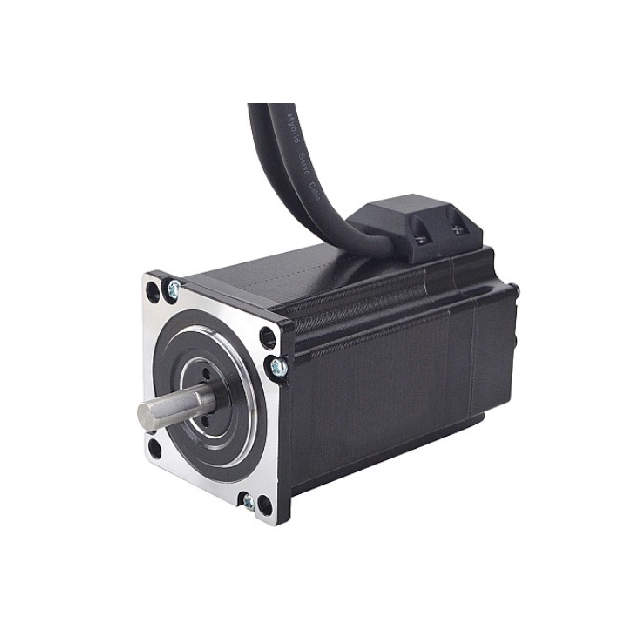
BF57HSN Series Closed-Loop Stepper Motor — High-Efficiency, Compact, and Smart Closed-Loop Motion Control Solution
Product Overview:The BESFOC NEMA 23 BF57HSN Series Stepper Motor is designed for precision motion-control applications requiring reliable positioning, stable torque output, and consistent rotational performance. Featuring a standardized NEMA 23 frame size, this stepper motor offers convenient mechanical integration into various industrial automation systems and equipment.
With its step-by-step positioning capability and compact structural design, the BF57HSN30 is suitable for applications involving controlled rotation, repetitive positioning, and automated motion sequences. It can be integrated with compatible stepper motor drivers and motion controllers to achieve accurate speed and position control.
Key Technical Highlights
- Standard NEMA 23 Frame Size: Features an approximately 57 mm mounting-face dimension, facilitating integration into compatible industrial equipment and mechanical assemblies.
- Precise Positioning Capability: Stepper motor technology enables controlled incremental rotation, making it suitable for repetitive positioning and accurate motion-control tasks.
- Stable Torque Output: Designed to provide controlled rotational force for applications requiring reliable movement and positioning under appropriately selected mechanical loads.
- Flexible Drive Compatibility: Can be integrated with compatible stepper motor drivers and motion controllers to support different positioning, speed-control, and automation requirements.
- Versatile Mechanical Integration: Suitable for various transmission configurations, including couplings, gearboxes, lead screws, and belt-driven mechanisms, depending on the application design.
Typical Applications
The NEMA 23 BF57HSN30 stepper motor can be considered for a variety of industrial automation and precision motion-control applications, including:
1. CNC Machines: Driving lead screws and positioning mechanisms for controlled movement along machine axes.
2. 3D Printers: Controlling linear movement and positioning mechanisms to support accurate printing operations.
3. Laser Engraving and Cutting Machines: Providing controlled movement for positioning laser heads and worktables.
4. Automated Packaging Equipment: Driving feeding, conveying, indexing, and positioning mechanisms in packaging systems.
5. Industrial Automation Systems: Supporting repetitive positioning, rotary indexing, and synchronized mechanical movements in automated production equipment.
3. Maintaining Stable Horizontal Pan Rotation Under Outdoor Disturbances
The horizontal pan axis is responsible for rotating the inspection camera around its vertical mounting axis.
In outdoor environments, this axis may experience changing resistance caused by wind pressure, cable drag, bearing friction, and the weight distribution of the camera assembly.
These disturbances can affect rotational accuracy and make it difficult to maintain consistent positioning.
Closed-loop stepper motors help improve horizontal rotation through encoder feedback and torque adjustment.
3.1 Compensating for Changing Mechanical Loads
When a camera rotates horizontally, its load may change depending on the mechanical structure and external conditions.
For example, a large optical inspection camera mounted on an extended bracket may generate different resistance during rotation depending on cable routing and structural alignment.
The encoder provides actual rotor-position information, allowing the driver to identify deviations from the commanded movement.
The control system can then adjust motor current and operation to reduce positioning errors within its operating limits.
3.2 Improving Repeatability During Multi-Point Inspection
At each inspection location, the camera may need to rotate to several specific horizontal angles.
For example, an electrical equipment inspection robot may be programmed to capture images at 0°, 45°, 90°, 135°, and 180°.
Accurate repeatability ensures that images collected during different inspection cycles have consistent viewing orientations.
This is particularly useful for image comparison, equipment condition monitoring, and automated defect detection.
3.3 Supporting Controlled Acceleration and Deceleration
Rapid camera rotation can introduce mechanical vibration, especially when the camera assembly has considerable inertia.
Closed-loop stepper motor drivers can work with motion controllers to implement controlled acceleration and deceleration profiles.
By reducing sudden changes in rotational speed, the system can improve camera stability and help minimize image blur during positioning.
4. Improving Vertical Tilt Control for Accurate Camera Alignment
The tilt axis controls the vertical viewing direction of the inspection camera.
Unlike horizontal rotation, vertical movement must directly overcome gravitational torque generated by the camera, mounting bracket, and other attached equipment.
This makes motor torque selection especially important.
For example, an outdoor inspection robot may use a thermal imaging camera to examine overhead electrical connections or monitor the temperature of equipment installed at different heights.
The tilt mechanism must move the camera smoothly and maintain its viewing angle without excessive vibration or unwanted downward movement.
4.1 Providing Sufficient Torque Against Gravity
The required motor torque depends on several mechanical factors:
Total camera and bracket weight.
Distance between the center of gravity and the tilt axis.
Gearbox reduction ratio.
Mechanical friction.
Acceleration requirements.
External disturbances.
By calculating the maximum expected gravitational torque, engineers can determine the motor's required torque capacity and select an appropriate transmission mechanism.
A closed-loop stepper motor can then use encoder feedback to monitor rotor position while the driver adjusts motor operation according to the load.
4.2 Maintaining Camera Position at Different Tilt Angles
When an inspection camera stops at a particular vertical angle, the positioning mechanism must maintain that orientation.
This is particularly important when capturing thermal images, reading equipment identification labels, or examining structural components.
Closed-loop stepper motors provide position feedback that helps the controller identify unwanted deviations.
However, maintaining the camera's mechanical position also depends on the motor's holding torque, driver current settings, gearbox characteristics, and mechanical design.
For applications involving heavy cameras or significant gravitational loads, an appropriately sized gearbox or mechanical brake may be necessary.
4.3 Reducing Positioning Errors During Repeated Vertical Scanning
Inspection robots often perform repeated upward and downward scanning movements.
An encoder-based feedback system helps maintain consistency between commanded and actual motor positions during these operations.
This supports more reliable camera alignment and reduces the risk of accumulated positioning errors associated with unverified open-loop movement.
5. Coordinating Dual-Axis Pan-Tilt Movement for Accurate Target Tracking
One of the most important advantages of a two-axis positioning system is its ability to coordinate horizontal and vertical camera movement.
In autonomous inspection applications, the target is not always located directly in front of the robot. It may be positioned above, below, or to either side of the camera.
The pan and tilt motors must therefore work together to achieve the required viewing direction.
A typical dual-axis control architecture includes:
One closed-loop stepper motor for horizontal pan movement.
One closed-loop stepper motor for vertical tilt movement.
Two independent motor drivers.
A central motion controller.
Encoder feedback from both motors.
Communication with the robot's navigation and vision systems.
The robot's visual recognition system identifies the inspection target and determines its relative position.
The motion controller then calculates the required pan and tilt angles and sends corresponding movement commands to both motor drivers.
Each motor operates according to its individual feedback loop, while the central controller coordinates the overall positioning sequence.
For example, when an autonomous inspection robot identifies a transformer connection located above and to the right of its current viewing direction, the controller can command simultaneous horizontal and vertical rotation.
The pan motor adjusts the camera's horizontal orientation, while the tilt motor changes its vertical angle.
By coordinating these movements, the camera can reach the target more efficiently than through independent sequential adjustments.
Dual-axis closed-loop stepper motor control improves positioning consistency, supports coordinated camera movement, and enables more flexible autonomous inspection operations.
6. Reducing Vibration and Improving Image Stability During Inspection
Image stability is essential for autonomous outdoor inspection robots.
Even when a camera reaches the correct target angle, mechanical vibration can reduce image sharpness and affect the performance of image-processing algorithms.
This is particularly important for applications involving:
Thermal imaging.
Optical character recognition.
Surface crack detection.
Equipment identification.
Visual inspection of electrical connections.
Long-distance optical monitoring.
Closed-loop stepper motors contribute to improved motion stability through controlled acceleration, deceleration, and position feedback.
When integrated with suitable motion-control algorithms, they can reduce abrupt movement and help the camera reach its target position smoothly.
Mechanical design also plays a major role.
We recommend considering the following factors when developing a stable pan-tilt assembly:
Rigid mounting structure: A rigid motor bracket reduces structural deformation and unwanted movement.
Appropriate gearbox selection: A suitable reduction ratio increases output torque and allows controlled camera rotation.
Balanced camera assembly: Positioning the center of gravity close to the tilt axis reduces gravitational torque.
Low-backlash transmission: Precision gearboxes and properly designed transmission components help improve angular repeatability.
Optimized acceleration profiles: Controlled motion reduces mechanical shock during starting and stopping.
For applications requiring image capture during movement, the camera system may also need electronic or optical image stabilization.
Motor feedback alone does not eliminate vibration from the robot chassis, mounting structure, or environmental disturbances. A complete solution combines motor control, mechanical engineering, and image stabilization.
7. Why Environmental Adaptability Matters for Outdoor Robotic Inspection
Autonomous outdoor inspection robots are designed to operate in environments where temperature, humidity, dust, rain, and mechanical vibration can change continuously. Unlike indoor robotic equipment, these inspection platforms may work across solar farms, electrical substations, agricultural fields, industrial pipelines, and remote infrastructure facilities. These operating conditions place additional demands on the reliability of their motion-control systems, particularly the pan-tilt mechanisms responsible for positioning cameras and inspection sensors.
For outdoor inspection robots, closed-loop stepper motors must deliver consistent positioning performance while maintaining reliable encoder feedback and stable operation under changing environmental conditions. If moisture enters the motor assembly, excessive heat affects electronic components, or vibration interferes with mechanical positioning, the inspection system may experience inaccurate camera alignment, intermittent operation, or unexpected downtime.
By selecting appropriately protected closed-loop stepper motors and optimizing their mechanical and electrical integration, we can improve the operational reliability of outdoor robotic inspection systems.
7.1 Maintaining Stable Motor Performance Under Temperature Fluctuations
Temperature variation is one of the most important environmental factors affecting outdoor motor applications. Autonomous inspection robots may operate under direct sunlight during summer or in low-temperature environments during winter. These temperature changes can influence motor winding resistance, permanent magnet characteristics, encoder performance, and driver electronics.
For example, when an inspection robot operates continuously in a solar farm, its pan-tilt motors may be exposed to elevated ambient temperatures while performing frequent camera positioning movements. Excessive motor temperature can increase winding losses, affect insulation life, and trigger thermal protection in the driver.
Closed-loop stepper motors help maintain controlled positioning, but appropriate thermal management is essential for reliable operation.
When selecting motors for outdoor inspection applications, we should evaluate the following factors:
Rated operating temperature: Ensure that the motor and encoder can operate within the expected ambient temperature range.
Winding insulation: Select appropriate insulation classes according to the motor's thermal requirements.
Heat dissipation: Consider the motor housing, mounting structure, installation space, and ventilation conditions.
Driver temperature protection: Use motor drivers with suitable overtemperature monitoring and protection.
Continuous operating load: Evaluate the motor's RMS current and thermal performance during repeated pan-tilt movements.
Proper motor sizing and thermal management help prevent overheating and maintain consistent positioning performance during extended outdoor inspection operations.
7.2 Protecting Motor and Encoder Components Against Dust and Moisture
Dust, rain, humidity, and airborne contaminants are common challenges in outdoor robotic inspection environments.
For example, agricultural inspection robots may operate in fields containing soil particles, crop residue, and water spray. Robots deployed in industrial facilities may encounter airborne dust, oil mist, or other contaminants.
These substances can affect motor bearings, electrical connectors, encoder components, and driver circuits if the system does not have adequate environmental protection.
We recommend considering several protective measures when designing outdoor pan-tilt positioning systems:
Appropriate IP protection rating: Select motors and enclosures with an ingress protection rating suitable for the expected exposure to dust and water. The required rating should be determined by the actual installation environment rather than assumed from the motor type.
Sealed electrical connectors: Use appropriately rated connectors and cable glands to reduce moisture penetration through electrical connection points.
Protected encoder housing: Ensure that encoder components and their electrical interfaces are adequately protected against environmental contamination.
Corrosion-resistant materials: Select suitable housing materials, surface treatments, and fasteners to reduce corrosion caused by moisture and outdoor exposure.
Cable management: Use flexible, abrasion-resistant cables and suitable routing methods to prevent damage during repeated pan and tilt rotation.
These measures help protect the complete motor assembly and maintain reliable feedback signals during long-term outdoor operation.
7.3 Improving Resistance to Mechanical Vibration and External Disturbances
Outdoor inspection robots frequently travel across uneven terrain, concrete surfaces, metal platforms, and industrial access roads. These movements generate mechanical vibration that can be transmitted through the robot chassis to the pan-tilt positioning mechanism.
Wind pressure can also introduce additional forces when the camera assembly is mounted on an exposed platform or uses a large optical lens.
Such disturbances may affect camera stability, increase mechanical wear, and create positioning deviations.
Closed-loop stepper motors provide encoder feedback that allows the driver to monitor rotor position and respond to detected deviations. However, encoder feedback alone cannot eliminate vibration originating from the robot chassis or mechanical transmission system.
To improve overall stability, we recommend combining closed-loop motor control with appropriate mechanical design.
Important considerations include:
Rigid motor mounting: Use sufficiently strong mounting brackets to minimize structural deformation.
Low-backlash gearboxes: Reduce unwanted angular movement between the motor and camera output shaft.
High-quality bearings: Select bearings capable of supporting the radial and axial loads generated during operation.
Mechanical balancing: Position the camera assembly's center of gravity as close to the tilt axis as practical.
Vibration isolation: Use suitable damping structures where necessary to reduce vibration transmission.
Optimized motion profiles: Apply controlled acceleration and deceleration to minimize mechanical shock.
By combining these measures, we can improve camera stability and reduce the influence of external disturbances on inspection accuracy.
7.4 Ensuring Reliable Encoder Feedback in Harsh Outdoor Environments
The encoder is one of the most important components in a closed-loop stepper motor system because it provides the actual rotor-position information required for feedback control.
In outdoor robotic inspection applications, encoder reliability directly affects the system's ability to detect positioning deviations and maintain accurate motor operation.
However, encoder performance can be influenced by excessive temperature, moisture, electrical interference, mechanical vibration, and unstable power supplies.
For example, an autonomous inspection robot operating near industrial electrical equipment may experience electromagnetic interference that affects sensitive feedback signals if the wiring and grounding are not properly designed.
To maintain reliable encoder feedback, we recommend:
Selecting encoders with suitable resolution and operating-temperature specifications.
Using shielded encoder cables where appropriate.
Separating encoder signal wiring from high-current motor power cables.
Implementing proper grounding and electrical noise suppression.
Selecting suitable encoder interfaces for the motor driver and controller.
Ensuring that encoder connectors are protected against moisture and vibration.
These measures help maintain stable feedback communication and support accurate pan-tilt positioning during continuous inspection operations.
7.5 Reducing Maintenance Requirements for Long-Term Outdoor Operation
Outdoor inspection robots are often deployed across large facilities or remote locations where frequent maintenance is inconvenient and expensive.
If a pan-tilt motor experiences repeated positioning errors, overheating, bearing wear, or encoder signal interruptions, the robot may need to stop operating until the problem is resolved.
Closed-loop stepper motors can provide useful feedback information for monitoring motor operation and identifying abnormal positioning behavior.
For example, a control system can monitor the difference between commanded and actual rotor positions. Repeated or excessive deviations may indicate increased mechanical resistance, an overloaded camera assembly, or a developing transmission problem.
When combined with appropriate diagnostic functions, such as motor temperature monitoring and driver fault reporting, this information can help maintenance personnel identify potential problems earlier.
We can further improve long-term reliability by incorporating:
Suitable motor torque margins.
Durable bearings and transmission components.
Proper cable protection.
Regular inspection of mechanical connections.
Appropriate lubrication and maintenance intervals.
Driver protection against overcurrent and overheating.
A properly designed closed-loop stepper motor system helps reduce positioning-related maintenance risks and supports more consistent operation throughout the service life of an outdoor inspection robot.
7.6 Selecting the Right Environmental Protection Configuration
Different outdoor inspection applications require different levels of environmental protection. A robot operating inside a partially enclosed industrial facility does not necessarily require the same motor protection configuration as one deployed in an agricultural field exposed to rain, dust, and mud.
Therefore, we should evaluate the complete operating environment before selecting a closed-loop stepper motor.
Environmental Factor
Potential Impact on Motor Systems
Recommended Design Consideration
High temperature
Motor overheating and electronic component stress
Thermal management and appropriate temperature ratings
Low temperature
Changes in lubrication characteristics and component performance
Low-temperature-compatible materials and lubricants
Dust
Contamination of bearings and electrical interfaces
Suitable sealed housing and IP protection
Rain and moisture
Corrosion and electrical insulation problems
Sealed connectors and appropriate enclosure protection
Mechanical vibration
Structural loosening and positioning instability
Rigid mounting and vibration-resistant design
Electromagnetic interference
Unstable encoder signals
Shielded cables and proper grounding
Wind loading
Increased camera resistance and mechanical torque
Adequate motor torque and balanced mechanical design
For demanding outdoor applications, we recommend evaluating the motor, encoder, driver, connectors, gearbox, and mounting structure as one integrated system rather than considering the motor alone.
By combining closed-loop stepper motors, reliable encoder feedback, appropriate IP-rated protection, effective thermal management, and vibration-resistant mechanical structures, we can develop pan-tilt positioning systems capable of operating consistently in demanding outdoor inspection environments.
8. Selecting the Right Closed-Loop Stepper Motor for Pan-Tilt Systems
Choosing the correct motor requires evaluating the complete mechanical and electrical requirements of the pan-tilt assembly.
Selecting a motor based only on its frame size or rated holding torque may result in insufficient dynamic performance or unnecessary energy consumption.
The following factors should be considered.
Selection Factor
Engineering Consideration
Motor torque
Must overcome camera weight, friction, gravity, and external disturbances
Motor size
Must fit the pan-tilt mechanism and mounting structure
Encoder resolution
Must satisfy the required position-feedback accuracy
Operating speed
Must support the required camera scanning speed
Gearbox ratio
Determines output torque, speed, and transmission characteristics
Positioning repeatability
Must meet the inspection system's angular consistency requirements
Operating temperature
Must match the outdoor working environment
Protection rating
Must provide appropriate resistance to dust and moisture
Communication interface
Must be compatible with the robot controller
Power consumption
Must match the robot's available electrical energy budget
8.1 Motor Torque and Load Inertia
The pan and tilt axes generally experience different mechanical loads.
The pan axis must overcome rotational inertia, bearing friction, and external resistance.
The tilt axis must additionally overcome gravitational torque.
Therefore, we recommend calculating the required torque independently for each axis.
A suitable safety margin should also be included to accommodate acceleration, mechanical wear, and changing operating conditions.
8.2 Encoder Resolution and Positioning Requirements
Encoder resolution influences the feedback system's ability to detect small changes in rotor position.
However, encoder resolution should not be confused with the actual positioning accuracy of the camera.
The complete positioning accuracy also depends on gearbox backlash, mechanical compliance, bearing clearance, structural deformation, transmission errors, and control-system calibration.
For precision inspection applications, these factors should be evaluated together.
8.3 Integrated Versus Separate Closed-Loop Stepper Motors
Engineers can choose between integrated closed-loop stepper motors and conventional motor-driver configurations.
An integrated closed-loop stepper motor combines the motor, encoder, and driver electronics within a compact assembly.
This configuration can simplify installation, reduce external wiring, and make system integration more convenient.
Separate motor and driver configurations provide greater flexibility when the application requires customized driver placement, specialized control interfaces, or specific thermal management arrangements.
The appropriate solution depends on the available installation space, control architecture, maintenance requirements, and environmental conditions.
9. Practical Applications of Closed-Loop Stepper Motors in Outdoor Inspection Robots
Closed-loop stepper motors can support a wide range of autonomous inspection applications.
9.1 Electrical Substation Inspection
Inspection robots in electrical substations must examine transformers, circuit breakers, insulators, and other electrical equipment.
A motorized pan-tilt camera allows the robot to inspect multiple components without changing its physical position.
Closed-loop stepper motors help maintain consistent camera angles during repeated inspection procedures.
9.2 Solar Farm Inspection
Large solar farms require regular inspection to identify damaged modules, abnormal temperatures, and potential electrical faults.
A pan-tilt positioning system allows an inspection camera or thermal imaging device to scan photovoltaic modules from different viewing angles.
Closed-loop stepper motors support repeatable positioning, helping inspection systems capture comparable images across multiple inspection cycles.
9.3 Agricultural Field Monitoring
Agricultural inspection robots may monitor crop growth, identify plant diseases, and collect environmental information.
Their cameras frequently need to adjust viewing angles to examine plants at different heights and positions.
Closed-loop stepper motors provide controlled rotational movement that supports automated scanning and target positioning.
9.4 Industrial Pipeline and Infrastructure Inspection
Pipeline inspection and industrial infrastructure monitoring often involve complex outdoor environments.
A pan-tilt camera system allows inspection robots to examine pipe connections, structural supports, valves, and other equipment.
Reliable motor positioning helps improve inspection coverage and supports consistent visual data collection.
10. Why Closed-Loop Stepper Motors Are Suitable for Autonomous Pan-Tilt Systems
Closed-loop stepper motors combine several characteristics that make them suitable for precision camera positioning.
High positioning controllability: Stepper motor technology provides precise incremental motion, while encoder feedback helps verify actual rotor movement.
Improved load adaptability: Feedback-based control can respond to positioning deviations caused by changing mechanical loads.
Stable low-speed operation: Properly configured closed-loop stepper systems can provide controlled movement for camera alignment and inspection scanning.
Compact integration: Integrated motor configurations can reduce wiring complexity and simplify mechanical installation.
Flexible system integration: Closed-loop stepper motors can be integrated into different robot architectures through compatible pulse-based or communication-based control interfaces.
These advantages make closed-loop stepper motors an attractive option for applications requiring accurate, repeatable, and controlled pan-tilt movement.
However, motor selection must always consider the actual load, transmission mechanism, operating speed, thermal requirements, and environmental conditions.
11. Future Development of Pan-Tilt Motion Control in Autonomous Inspection Robots
As autonomous inspection technology develops, camera positioning systems are becoming increasingly integrated with artificial intelligence, machine vision, and intelligent navigation platforms.
Future inspection robots will require more sophisticated motion-control capabilities to support real-time target recognition and adaptive inspection procedures.
Several technological developments are particularly relevant.
AI-based target tracking: Machine vision algorithms can identify inspection targets and calculate the required camera orientation automatically.
Multi-sensor integration: Optical cameras, infrared sensors, and LiDAR systems can share a common positioning platform to collect complementary inspection data.
Intelligent motion planning: Advanced controllers can optimize pan-tilt trajectories to reduce unnecessary movement and improve inspection efficiency.
Predictive maintenance: Motor feedback and operating data can help identify abnormal positioning behavior and potential mechanical problems.
Wireless robotic coordination: Multiple inspection robots can exchange inspection information and coordinate monitoring activities across large facilities.
Within these developments, closed-loop stepper motors will continue to provide an important motion-control foundation for compact and reliable positioning mechanisms.
Conclusion
Precise pan-tilt control is essential for autonomous outdoor inspection robots that must capture accurate visual and thermal information across large and complex environments.
Closed-loop stepper motors improve pan-tilt positioning by combining stepper motor motion control with encoder-based feedback. This allows the control system to monitor actual rotor movement, detect positioning deviations, and adjust motor operation when necessary.
For horizontal pan movement, they support repeatable scanning and controlled camera rotation. For vertical tilt movement, they help maintain accurate camera orientation while managing changing mechanical loads and gravitational torque. When both axes operate together, they provide flexible dual-axis positioning for automated target inspection.
By combining appropriately selected closed-loop stepper motors with precision gearboxes, suitable encoders, robust mechanical structures, and intelligent motion controllers, we can develop pan-tilt systems that deliver reliable positioning performance in demanding outdoor inspection environments.
For manufacturers developing autonomous inspection robots, selecting the right closed-loop stepper motor solution is an important step toward improving camera positioning accuracy, inspection consistency, and overall robotic system reliability.
FAQs
1. How do closed-loop stepper motors improve pan-tilt control in autonomous outdoor inspection robots?
Closed-loop stepper motors improve pan-tilt control by combining precise stepper motor movement with encoder-based position feedback. The encoder monitors actual rotor position and sends feedback to the motor driver, allowing the system to detect positioning deviations and adjust motor operation. This helps autonomous inspection robots achieve more accurate, repeatable horizontal and vertical camera positioning.
2. Why are closed-loop stepper motors suitable for dual-axis pan-tilt camera systems?
Closed-loop stepper motors are suitable for dual-axis pan-tilt systems because they provide controlled positioning, encoder feedback, and reliable low-speed operation. Two independently controlled motors can manage horizontal pan and vertical tilt movements simultaneously or sequentially, allowing inspection cameras to target equipment at different heights and viewing angles.
3. How does encoder feedback improve camera positioning accuracy in outdoor inspection robots?
Encoder feedback continuously monitors the actual rotor position and compares it with the commanded position. When a deviation occurs, the closed-loop driver can adjust motor operation to reduce the positioning error. This helps maintain consistent camera alignment during repeated inspection movements and reduces the risk of undetected position loss associated with open-loop operation.
4. How do closed-loop stepper motors maintain stable vertical tilt positioning against gravity?
Closed-loop stepper motors use encoder feedback to monitor rotor movement and maintain controlled positioning under changing mechanical loads. For vertical tilt mechanisms, engineers must calculate gravitational torque based on camera weight and the distance between its center of gravity and the tilt axis. An appropriately sized motor, suitable gearbox, and sufficient holding torque help maintain stable camera positioning.
5. Can closed-loop stepper motors support synchronized pan and tilt movements?
Yes. Two closed-loop stepper motors can be coordinated through a central motion controller. One motor controls horizontal pan rotation, while the other controls vertical tilt movement. The controller calculates the required target angles and sends synchronized motion commands to both drivers, enabling the inspection camera to reach specific targets efficiently.
6. How do closed-loop stepper motors reduce vibration during camera positioning?
Closed-loop stepper motors support smoother camera positioning through controlled acceleration, deceleration, and encoder-based feedback. When combined with low-backlash gearboxes, balanced camera assemblies, rigid mounting structures, and optimized motion profiles, they help reduce mechanical shock and unwanted movement during inspection operations.
7. What environmental protection should closed-loop stepper motors have for outdoor inspection robots?
Outdoor inspection applications may require protection against dust, moisture, rain, temperature fluctuations, and mechanical vibration. Engineers should evaluate the motor's IP protection rating, encoder enclosure, connector sealing, operating temperature range, and cable protection. The required protection level depends on the actual operating environment and installation conditions.
8. How do you select the right closed-loop stepper motor for a pan-tilt inspection system?
Motor selection should consider camera weight, load inertia, gravitational torque, required rotational speed, encoder resolution, positioning repeatability, gearbox ratio, and installation space. Engineers should calculate the torque requirements of the pan and tilt axes separately because vertical movement must overcome gravitational loading. Environmental protection and driver compatibility should also be evaluated.
9. What is the difference between open-loop and closed-loop stepper motors in pan-tilt positioning applications?
Open-loop stepper motors estimate rotor position based on commanded input pulses without independently verifying actual movement. Closed-loop stepper motors use encoder feedback to monitor rotor position and identify deviations. This feedback improves positioning reliability under changing loads and helps prevent undetected position errors during repetitive camera scanning operations.
10. Where are closed-loop stepper motors used in autonomous outdoor inspection systems?
Closed-loop stepper motors are used in pan-tilt camera systems for electrical substation inspection robots, solar farm monitoring equipment, agricultural inspection robots, pipeline monitoring platforms, and industrial infrastructure surveillance systems. They provide controlled camera positioning for optical cameras, thermal imaging sensors, and other inspection devices that require repeatable viewing angles.

 English
 العربية
 Français
 Русский
 Español
 Português
 Deutsch
 italiano
 日本語
 한국어
 Nederlands
 Tiếng Việt
 ไทย
 Polski
 Türkçe
 ພາສາລາວ
 ភាសាខ្មែរ
 Bahasa Melayu
 ဗမာစာ
 Filipino
 Bahasa Indonesia
 magyar
 Română
 Čeština
 Монгол
 қазақ
 Српски
 हिन्दी
 فارسی
 Slovenčina
 Slovenščina
 Norsk
 Svenska
 українська
 Ελληνικά
 Suomi
 Հայերեն
 עברית
 Latine
 Dansk
 Shqip
 বাংলা
 Hrvatski
 Afrikaans
 Gaeilge
 Eesti keel
 Oʻzbekcha
 latviešu
 Azərbaycan dili
 Български
 Català