Integrated Servo Motors & Linear Motions Supplier 

-Tel
86- 18761150726
-Whatsapp
86-13218457319
-E-mail
Home / Integrated Stepper Servo Motor

Integrated Stepper Servo Motors

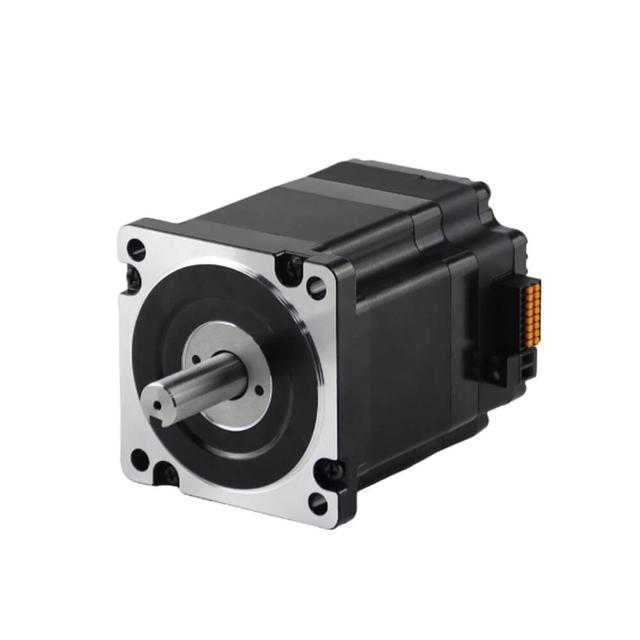
An Integrated Stepper Servo Motor combines a stepper motor, servo control technology, encoder feedback, and motor driver into a compact all-in-one motion control solution. Unlike traditional open-loop stepper motors, integrated stepper servo motors provide real-time position feedback, improved torque utilization, higher accuracy, and reduced risk of step loss.

By integrating the motor, driver, and controller interface into a single unit, these motors simplify system design, reduce wiring complexity, save installation space, and improve reliability in industrial automation applications.

Integrated stepper servo motors are widely used in CNC machines, robotics, AGV/AMR mobile robots, medical equipment, packaging machinery, semiconductor equipment, textile machines, and precision automation systems.

What Is an Integrated Stepper Servo Motor?

An integrated stepper servo motor is a closed-loop stepper motor system that integrates:

  • Stepper motor
  • Servo drive electronics
  • Encoder feedback system
  • Microstepping control
  • Communication interface

into one compact housing.

Traditional stepper motors operate in an open-loop system, meaning the controller assumes the motor reaches the commanded position. However, external loads, acceleration changes, or mechanical resistance can cause missed steps.

A closed-loop integrated stepper servo motor continuously monitors motor position through an encoder and automatically adjusts current output to maintain accurate positioning.

This provides servo-like performance while maintaining the simplicity and cost advantages of stepper motor technology.

Key Features of Integrated Stepper Servo Motors

1. Closed-Loop Position Control

The built-in encoder provides real-time feedback, allowing the motor controller to detect and correct position errors.

Benefits include:

  • No step loss
  • Higher positioning accuracy
  • Improved dynamic response
  • Stable operation under variable loads

This makes integrated stepper servo motors ideal for applications requiring reliable precision motion.


2. Built-In Motor Driver

Unlike conventional stepper motors that require an external driver, integrated stepper servo motors include an internal driver.

Advantages:

  • Reduced wiring
  • Smaller control cabinet
  • Faster installation
  • Lower system cost
  • Improved EMC performance

This design is especially suitable for compact automation equipment and distributed motion systems.


3. Multiple Communication Options

Modern integrated stepper servo motors support various industrial communication protocols:

  • Pulse & Direction control
  • RS485 Modbus RTU
  • CANopen
  • EtherCAT
  • RS232 communication

These communication options allow easy integration into PLC systems, industrial controllers, and robotic platforms.


4. High Torque Density and Compact Design

The integrated structure reduces the need for external electronics and cables, creating a compact motor solution with excellent torque output.

Common configurations include:

  • NEMA 17 integrated stepper servo motor
  • NEMA 23 integrated stepper servo motor
  • NEMA 24 integrated stepper servo motor
  • NEMA 34 integrated stepper servo motor

Different frame sizes can meet various automation requirements.


Integrated Stepper Servo Motor vs Traditional Stepper Motor

Feature Traditional Stepper Motor Integrated Stepper Servo Motor
Control Mode Open loop Closed loop
Feedback No encoder Encoder feedback
Step Loss Possible Automatically corrected
Driver External Built-in
Wiring More cables Simplified
Accuracy Medium High
System Integration Requires tuning Easy installation
Cost Lower Higher performance/value

For applications requiring reliable positioning and continuous operation, integrated stepper servo motors provide a better balance between performance and cost.


Applications of Integrated Stepper Servo Motors

Industrial Automation

Integrated stepper servo motors are widely used in automated production equipment requiring accurate positioning and repeatability.

Applications include:

  • Assembly machines
  • Pick-and-place systems
  • Conveyor systems
  • Inspection equipment
  • Industrial robots
 

CNC Machines

CNC routers and engraving machines require precise movement control.

Integrated stepper servo motors provide:

  • Accurate X/Y/Z axis positioning
  • Smooth motion performance
  • Reduced vibration
  • Better machining quality
 

AGV and AMR Robots

Autonomous mobile robots require compact and reliable drive solutions.

Integrated stepper servo motors offer:

  • Compact installation
  • Low maintenance
  • Encoder feedback
  • CAN communication
  • Precise wheel control

They are suitable for:

  • Warehouse robots
  • Delivery robots
  • Logistics automation systems
 

Medical and Laboratory Equipment

Medical automation equipment requires accurate and stable motion.

Applications include:

  • Liquid handling systems
  • Medical pumps
  • Diagnostic equipment
  • Laboratory automation
 

Packaging Machinery

Integrated stepper servo motors improve speed and accuracy in:

  • Filling machines
  • Labeling machines
  • Sealing machines
  • Sorting equipment


Advantages of Integrated Stepper Servo Motors

An Integrated Stepper Servo Motor combines a stepper motor, servo driver, encoder, and control electronics into a single compact unit. Compared with traditional open-loop stepper motors and conventional servo systems, integrated stepper servo motors provide improved accuracy, simplified installation, higher reliability, and better system performance.

The main advantages include:


1. Closed-Loop Control for Higher Positioning Accuracy

One of the biggest advantages of an integrated closed-loop stepper servo motor is its built-in feedback system.

Traditional stepper motors operate in an open-loop mode, meaning the controller sends pulses without knowing whether the motor actually reaches the commanded position. Under heavy loads, sudden acceleration, or mechanical resistance, missed steps may occur.

Integrated stepper servo motors use encoder feedback to monitor the actual motor position in real time and automatically compensate for errors.

Benefits:

  • Prevents step loss
  • Maintains accurate positioning
  • Improves repeatability
  • Provides stable operation under variable loads
  • Enhances machine reliability

This makes them ideal for precision applications such as CNC equipment, robotics, medical automation, and industrial machinery.


2. Motor, Driver, and Encoder Integration

An integrated stepper servo motor combines multiple components into one compact assembly:

  • Stepper motor
  • Motor driver
  • Encoder
  • Communication interface
  • Control electronics

This integrated design eliminates the need for separate external drivers and reduces system complexity.


Advantages include:

  • Less wiring
  • Reduced installation time
  • Smaller control cabinet requirements
  • Fewer connection points
  • Improved system reliability

For equipment manufacturers, this helps simplify machine design and shorten development cycles.


3. Space-Saving Compact Design

The built-in driver and electronics significantly reduce the overall system footprint.

Compared with traditional motion systems that require:

  • External stepper driver
  • Additional cables
  • Control cabinet space
  • Separate feedback devices

integrated stepper servo motors offer a cleaner and more compact solution.

They are especially suitable for applications where installation space is limited, such as:

  • AGV robots
  • AMR mobile robots
  • Desktop CNC machines
  • Laboratory automation equipment
  • Compact robotic systems
 

4. Improved Torque Utilization and Energy Efficiency

Unlike open-loop stepper motors that continuously operate at a fixed current level, integrated stepper servo motors dynamically adjust motor current based on actual load requirements.

This provides:

  • Lower power consumption
  • Reduced motor heating
  • Improved efficiency
  • Better torque utilization

The motor only delivers the required current, improving energy efficiency during different operating conditions.


5. Servo-Like Performance at a Lower Cost

Integrated stepper servo motors combine the simplicity and affordability of stepper motors with many advantages of servo systems.

Compared with traditional servo motors, they provide:

Feature Integrated Stepper Servo Motor Traditional Servo Motor
Feedback Encoder feedback Encoder feedback
Control Complexity Simple More complex
Cost Lower Higher
Installation Easy Requires tuning
Maintenance Low Medium
Position Accuracy High Very high

For many automation applications requiring reliable positioning but not extreme speed, integrated stepper servo motors provide an excellent cost-performance balance.


6. Easy Installation and Commissioning

The integrated structure simplifies machine installation.

Users can benefit from:

  • Plug-and-play configuration
  • Reduced wiring requirements
  • Faster commissioning
  • Easier troubleshooting

Many models support standard control methods such as:

  • Pulse & Direction
  • RS485 Modbus RTU
  • CANopen
  • EtherCAT

This allows quick integration with PLCs, industrial controllers, and automation platforms.


7. Multiple Communication Options for Industrial Automation

Modern integrated stepper servo motors support various communication protocols to meet different automation requirements.

Common options include:

Pulse Control

Suitable for:

  • CNC machines
  • Simple positioning systems
  • Standalone automation equipment
 

RS485 Modbus RTU

Suitable for:

  • Multi-axis automation systems
  • Industrial equipment networking
  • Distributed control applications
 

CANopen

Suitable for:

  • AGV/AMR robots
  • Robotics
  • Intelligent manufacturing systems
 

EtherCAT

Suitable for:

  • High-speed motion control
  • Multi-axis robotic systems
  • Advanced industrial automation
 

8. Higher Reliability and Lower Maintenance

The integrated design reduces the number of external components, which helps improve system reliability.

Advantages:

  • Fewer cables and connectors
  • Reduced risk of wiring errors
  • Better resistance to vibration
  • Lower maintenance requirements
  • Longer operational life

This is especially valuable for industrial equipment operating continuously in demanding environments.


9. Reduced Machine Development Time

For OEM equipment manufacturers, integrated stepper servo motors simplify mechanical and electrical design.

Benefits include:

  • Faster product development
  • Reduced engineering workload
  • Easier inventory management
  • Simplified installation procedures

Manufacturers can focus more on machine optimization instead of designing complex motor-drive systems.


10. Flexible Customization for Different Applications

Professional integrated stepper servo motor manufacturers can provide customized solutions according to application requirements.

Customization options include:

  • Motor frame size (NEMA 17, NEMA 23, NEMA 34, etc.)
  • Encoder resolution
  • Communication protocols
  • Voltage options
  • Shaft design
  • Gearbox integration
  • Protection rating (IP54, IP65, IP67)
  • Connector and cable solutions

This makes integrated stepper servo motors suitable for a wide range of industrial applications.


Summary: Why Choose Integrated Stepper Servo Motors?

The key advantages of integrated stepper servo motors include:

✔ Closed-loop positioning accuracy

✔ Built-in driver and encoder

✔ Compact space-saving design

✔ Lower wiring complexity

✔ Better energy efficiency

✔ Servo-like performance at lower cost

✔ Easy PLC and industrial network integration

✔ High reliability and low maintenance

✔ Faster machine development

✔ Flexible OEM customization


How to Choose an Integrated Stepper Servo Motor?

When selecting an integrated stepper servo motor, consider:

1. Required Torque

Calculate the load torque and acceleration requirements.

Common torque ranges:

  • 0.1 Nm – 1 Nm for compact automation
  • 1 Nm – 5 Nm for industrial equipment
  • Higher torque models for CNC and robotics
 

2. Communication Interface

Choose according to your control system:

  • Pulse input → Simple motion control
  • RS485 Modbus → Industrial networking
  • CANopen → Robotics and automation
  • EtherCAT → High-performance systems
 

3. Encoder Type

Common encoder options:

  • Incremental encoder
  • Magnetic encoder
  • Optical encoder
  • Absolute encoder

Higher-resolution encoders provide better positioning accuracy.


4. Motor Size

Popular options:

  • Integrated NEMA 17 stepper servo motor
  • Integrated NEMA 23 stepper servo motor
  • Integrated NEMA 34 stepper servo motor


Answers to Common Queries about BesFoc

  • 1、What is an integrated stepper servo motor?
    Created with Sketch.
    形状 Created with Sketch.
    An integrated stepper servo motor combines a stepper motor, built-in motor driver, encoder feedback system, and control electronics into one compact unit. Compared with traditional stepper motor systems that require separate drivers and complex wiring, integrated stepper servo motors provide easier installation, improved reliability, and precise closed-loop motion control for industrial automation applications.
  • 2、What are the advantages of an integrated stepper servo motor?
    Created with Sketch.
    形状 Created with Sketch.

    The main advantages of an integrated stepper servo motor include compact design, reduced wiring, improved positioning accuracy, lower installation costs, and enhanced motion performance. The built-in encoder enables real-time feedback, helping prevent step loss and improving stability during high-speed or high-load operation.

  • 3、What control methods are supported by integrated stepper servo motors?
    Created with Sketch.
    形状 Created with Sketch.
    Integrated stepper servo motors support multiple control methods, including pulse and direction control, RS485 Modbus-RTU communication, CANopen communication, and customized industrial communication solutions. These options allow easy integration with PLC systems, motion controllers, and industrial automation equipment.
  • 4、What is the difference between a stepper motor and an integrated stepper servo motor?
    Created with Sketch.
    形状 Created with Sketch.
    A traditional stepper motor usually operates in open-loop control without position feedback, while an integrated stepper servo motor uses encoder feedback and closed-loop control technology. This allows the motor to automatically monitor position errors, improve accuracy, reduce vibration, and maintain reliable performance under changing loads.
  • 5、What encoder options are available for integrated stepper servo motors?
    Created with Sketch.
    形状 Created with Sketch.
    Integrated stepper servo motors can be equipped with high-resolution magnetic encoders or incremental encoders depending on application requirements. Encoder feedback provides real-time position monitoring and improves motion accuracy for applications requiring precise positioning and repeatability.
  • 6、What applications use integrated stepper servo motors?
    Created with Sketch.
    形状 Created with Sketch.
    Integrated stepper servo motors are widely used in CNC machines, robotics, AGV mobile robots, medical equipment, packaging machinery, semiconductor equipment, laboratory automation, textile machines, and precision positioning systems where compact design and accurate motion control are required.
  • 7、Are integrated stepper servo motors available with gearboxes?
    Created with Sketch.
    形状 Created with Sketch.
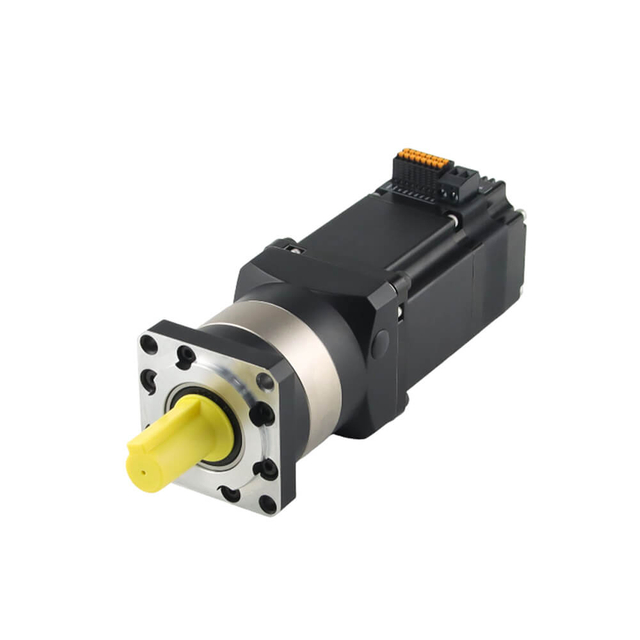
    Yes. Integrated stepper servo motors can be customized with planetary gearboxes, worm gearboxes, and other reduction solutions. Geared integrated stepper servo motors provide higher output torque, lower speed operation, and improved load handling capability for demanding automation applications.
  • 8、What voltage and motor sizes are available for integrated stepper servo motors?
    Created with Sketch.
    形状 Created with Sketch.
    Integrated stepper servo motors are available in various frame sizes including NEMA 8, NEMA 11, NEMA 17, NEMA 23, NEMA 24, and NEMA 34. Typical operating voltage ranges include DC12V to DC36V depending on the motor model and application requirements.
  • 9、Are waterproof integrated stepper servo motors available?
    Created with Sketch.
    形状 Created with Sketch.
    Yes. Waterproof integrated stepper servo motors are available with different protection levels such as IP30, IP54, and IP65 options. These motors are suitable for applications exposed to dust, moisture, and harsh industrial environments, including outdoor equipment and mobile robotics.
  • 10、How do I choose the right integrated stepper servo motor?
    Created with Sketch.
    形状 Created with Sketch.
    To select the right integrated stepper servo motor, consider required torque, speed, load inertia, positioning accuracy, communication protocol, voltage, protection rating, and installation space. A professional motor manufacturer can provide customized solutions based on your automation system requirements.
Leading Integrated Servo Motors & Linear Motions Supplier
Products
Links
Inquiry Now

© COPYRIGHT 2024 CHANGZHOU BESFOC MOTOR CO., LTD ALL RIGHTS RESERVED.